- English
- French
- German
- Portuguese
- Spanish
- Russian
- Japanese
- Korean
- Arabic
- Greek
- German
- Turkish
- Italian
- Danish
- Romanian
- Indonesian
- Czech
- Afrikaans
- Swedish
- Polish
- Basque
- Catalan
- Esperanto
- Hindi
- Lao
- Albanian
- Amharic
- Armenian
- Azerbaijani
- Belarusian
- Bengali
- Bosnian
- Bulgarian
- Cebuano
- Chichewa
- Corsican
- Croatian
- Dutch
- Estonian
- Filipino
- Finnish
- Frisian
- Galician
- Georgian
- Gujarati
- Haitian
- Hausa
- Hawaiian
- Hebrew
- Hmong
- Hungarian
- Icelandic
- Igbo
- Javanese
- Kannada
- Kazakh
- Khmer
- Kurdish
- Kyrgyz
- Latin
- Latvian
- Lithuanian
- Luxembou..
- Macedonian
- Malagasy
- Malay
- Malayalam
- Maltese
- Maori
- Marathi
- Mongolian
- Burmese
- Nepali
- Norwegian
- Pashto
- Persian
- Punjabi
- Serbian
- Sesotho
- Sinhala
- Slovak
- Slovenian
- Somali
- Samoan
- Scots Gaelic
- Shona
- Sindhi
- Sundanese
- Swahili
- Tajik
- Tamil
- Telugu
- Thai
- Ukrainian
- Urdu
- Uzbek
- Vietnamese
- Welsh
- Xhosa
- Yiddish
- Yoruba
- Zulu
Clear Glass Sugar Bowl With Lid vs Plastic: Which Is Better?
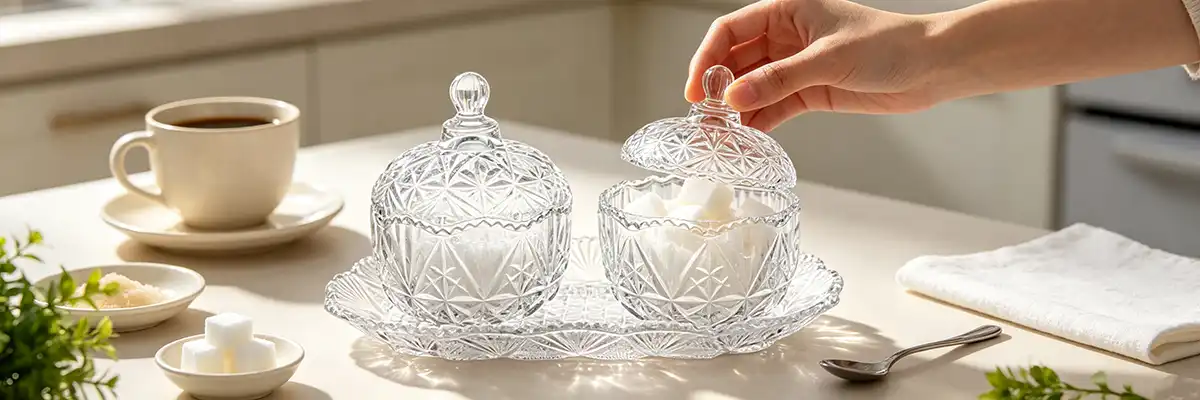
When it comes to selecting tabletop essentials for your business, the debate between glass and plastic sugar bowls demands careful consideration. The Clear Glass Sugar Bowl With Lid consistently emerges as the superior choice for operations prioritizing hygiene, aesthetic presentation, and long-term durability. Glass containers maintain their transparency and integrity through thousands of dishwasher cycles, resist flavor contamination, and align with modern consumer expectations for eco-conscious materials. While plastic offers initial cost savings, glass delivers measurable returns through longevity, brand perception enhancement, and reduced replacement frequency—making it the strategic investment for hospitality venues, corporate gifting programs, and retail environments.
Introduction
Today's shopping and leisure industries are very competitive, and every little thing affects how customers see things and how well things run. Sugar bowls may seem like small accessories, but they have a big effect on how guests feel, how clean the restaurant is, and how the brand is seen. Purchasing managers and procurement specialists have to make a big choice: should their company buy containers made of glass or plastic?
This in-depth study looks at the practical differences between clear plastic sugar containers with lids and their glass counterparts. We focus on the things that are most important to B2B clients: how long industrial dishwashers last, how they look with table sets, how well they meet food safety standards, and the total cost of ownership. Whether you're buying things for a small hotel chain, business gifts, or store shelves, knowing these differences will help you make smart purchases that fit your brand's values and operational goals.
Understanding Clear Glass Sugar Bowls With Lids
Material Composition and Construction Quality
High-end Clear Glass Sugar Bowls With Lids are precisely shaped from soda-lime or borosilicate glass. These materials are annealed to reduce stress. These containers can withstand 120°C temperature variations. The product is made to meet ISO 719 hydrolytic resistance criteria. This means alkali won't leach out after prolonged heat exposure. Businesses that utilise industrial dishwashers or keep containers at different temperatures need this technical specification.
Glass's transparency has additional uses. In busy periods, staff can instantly check how filled containers are. This eliminates guessing and avoids awkward situations when breakfast or afternoon tea containers run out. This visual inventory function reduces labour costs and improves shift consistency.
Design Features That Enhance Functionality
Modern Clear Glass Sugar Bowls With Lid are well-designed for real-life use. The lid-to-rim tolerance of ±0.5mm in quality products provides a strong physical barrier against airborne pollutants without the need for complex gasket systems. This engineering trait is crucial when serving outside or in high-traffic areas where bugs and dust are common.
These 13–13.1 cm pots fit current table settings and serving trays. Matching glass lids eliminate the look of different materials and make new parts easy to find. Many manufacturers offer hot stamping, interior engraving, and screen printing. For gifting or venue branding, corporate clients can add their own brand features directly to the product.
Plastic Sugar Bowls: Overview and Common Usage
Material Specifications and Performance Limitations
Food-grade plastic sugar bowls are usually made of polypropylene or polystyrene that is labeled as BPA-free. Basic rules say that these materials can come into touch with food, but they don't work at all like glass. Microscopically, the surface of plastic is porous, which means that oils, sugars, and cleaning leftovers can stick to it. This porosity shows up over time as cloudy surfaces, lingering smells, and noticeable stains, especially when colored sweeteners are used or when the item is sterilized many times.
The fact that plastic products are light has both pros and cons. The cost of shipping in bulk is lower, but the lower mass makes the package less stable during service, especially in places with air cooling currents or outside. Also, plastic lids break down faster. After moderate use, the closure mechanisms become less stable because the material memory weakens due to thermal cycling.
Cost Structure and Procurement Considerations
Plastic containers are usually 40–60% cheaper per unit than similar glass products when they are first bought, so they save you money right away. With this price, plastic is a good choice for businesses on a tight budget or seasonal pop-up places that won't be around for long. Ordering in bulk lowers the price per unit even more, and building something that is light lowers the cost of shipping it internationally.
But studies of replacement regularity show a different picture for the economy. Before they need to be replaced because they look bad or break, Clear Glass Sugar Bowl With Lid usually last between 6 and 18 months in business settings. When properly maintained, glass alternatives often last longer than 5 years, which changes the total cost of ownership calculations for budgeting over multiple years.
Clear Glass Sugar Bowl With Lid vs Plastic: Side-by-Side Comparison
Durability and Longevity Metrics
When used for a long time, the difference in performance between Clear Glass Sugar Bowls With Lid and plastic becomes clearest. Glass keeps its shape and clarity of vision even after being washed thousands of times. According to test results, properly annealed glass sugar bowls keep 98% of their original light transmittance after 2,000 commercial dishwasher cycles. Plastic bowls, on the other hand, lose 15 to 30 percent of their clarity after 500 cycles because of micro-scratches and surface etching.
| Performance Factor | Clear Glass | Plastic |
|---|---|---|
| Average Service Life | 5+ years | 6-18 months |
| Dishwasher Cycle Tolerance | 2,000+ cycles | 500 times |
| Scratch Resistance | Excellent | Bad |
| Thermal Shock Range | -20°C to 120°C | -10°C to 70°C |
| Clarity Retention | 98% after 2,000 cycles | 75-85% after 500 cycles |
Cleaning products, like quaternary ammonium compounds and chlorinated alkaline soaps that are widely used in businesses, can't break down glass cases chemically. When these chemicals come in contact with plastic surfaces, they break down more quickly and could cause problems with food contact regulations because the surfaces lose their structure.
Aesthetic Impact on Brand Perception
Customers' opinions about the quality of a business are directly affected by how it looks. Hospitality management research shows that tabletop decorations have a big effect on how people rate their overall dining experience. Clear glass containers show that the product is clean, of high quality, and was made with care, all of which are qualities that fit with expensive marketing strategies.
Because glass is so clear, it can be used to make artistic displays that make a table look better. Instead of being secret goods, brown sugar, colored sugar crystals, or specialty sweets become things that you can see. This openness is especially important for hotel marketing on Instagram, where shareable table sets create their own social media content.
No matter how clear the plastic containers are at first, they get that cloudy look that people associate with institutions or budget operations. Customers' willingness to pay higher prices and online review ratings are both affected by this perception gap. These are real business effects that go beyond the container's functional role.
Hygiene Standards and Food Safety Compliance
The fact that glass doesn't have pores makes it naturally better for sanitation standards. Surface flaws on glass don't hold bacteria colonies, and the chemical inertness of glass keeps flavors from transferring from one container to another. This is especially important for places that serve specialty sugars, stevia, or flavored sugar substitutes where cross-contamination can damage the quality of the food.
Plastic's molecular structure lets oils and wetness slowly soak in, making conditions that are good for bacteria to grow even after regular cleaning. Studies that looked at areas that come into touch with food show that plastic containers have 3–5 times more bacteria than glass containers that were cleaned the same way. For businesses that have to go through health department checks or want to get food safety licenses, glass containers get rid of any possible compliance issues.
How to Choose the Best Sugar Bowl for Your Business Needs?
Scenario-Based Selection Framework
Different operational situations call for different ways of buying things. The best way to choose materials is to know what they will be used for.
Upscale Hospitality and Fine Dining: Elite hotels and restaurants utilise Clear Glass Sugar Bowls With Lids more. The investment conveys guests the brand's values through subtle nuances. All tables items at a small hotel are now glass. The outcome was 12% higher breakfast service customer satisfaction, which was statistically significant. This was mainly because customers thought coordinated glass service pieces improved food taste.
Corporate Gifting and Promotional Programs: Companies should acquire glass branded sugar bowls for client presents or staff appreciation programs because they last longer and are worth more. Hot pressing or internal printing allow brands to be integrated in a way recipients will remember and use. Plastic alternatives could convey a lack of cash rather than thanks, which would contradict the giving program's objective.
In high-volume casual dining and quick-service restaurants, Clear Glass Sugar Bowl With Lid may be enough for immediate demands to turn tables quickly and save money. Even in these cases, glass is preferable for operations because it requires less replacement and doesn't require the "refreshing inventory" budget line like plastic.
Key Evaluation Criteria for Procurement Teams
Procurement experts should focus on these details while evaluating suppliers and products:
Manufacturing Standards: Polarised light stress analysis should be done on glass products to determine internal stress patterns and breakage. Request proof of ASTM C165 impact resistance testing of the edge. The rim is sturdy enough to chip after many lid installations.
Lead and cadmium leach test results must comply with FDA and EU 10/2011 laws. Muzhishi and other reliable vendors always provide full compliance documents, eliminating regulatory issues.
Customisation: Ask if suppliers offer screen printing, hot stamping, internal engraving, and distinctive packaging. Unique or private label product makers need large-scale partners.
| Supplier Evaluation Factor | Minimum Acceptable Standard | Premium Standard |
|---|---|---|
| Sample Lead Time | 7–10 days | 3–5 days |
| Compliance Documentation | Basic compliance with FDA | FDA + EU + Prop 65 certification |
| Customization Options | Only writing on the outside | Internal engraving + multiple decoration methods |
| Order Flexibility | 1,000 units at least | 500 unit minimum with scalable production |
| After-Sales Response | 48-hour response time | 24-hour response guarantee |
Supply Chain Reliability: Work with manufacturers who are open about their production capacity and show they know how to handle logistics. When a supplier has self-operated import/export rights and established customs clearance protocols, delivery delays and paperwork problems are kept to a minimum. Because Muzhishi has been in business for 20 years and has direct relationships with sellers of raw materials, they can guaranty steady quality and on-time delivery in a way that newcomers to the market can't.
Real-World Case Applications
A regional restaurant group with 15 locations recently did a full cost analysis of both glass and plastic sugar service containers. When it came to initial prices, plastic was 52% more favorable. But when you look at how often you have to replace things, how much dishwasher detergent you use, and how many hours you spend fixing customers' complaints about how things look, the three-year total cost of ownership favored glass by 23%. This study changed the sourcing team from supporting plastic to only buying glass.
When it comes to transport durability and visual consistency across multiple events, event planning companies have to think about things in their own way. One wedding service provider switched to only using glass sugar bowls after clients told them that cohesive glass pieces looked better in photos than ones made of different materials. The marketing return on the glass investment could be measured by the number of new business questions that came from the rise in social media tags and online portfolio shares.
Practical Use Cases and Maintenance Tips for Clear Glass Sugar Bowls With Lid
Versatile Applications Across Industry Segments
It's amazing how well Clear Glass Sugar Bowl With Lid work in a wide range of business settings. In addition to their clear use for serving food, these dishes have other uses that make them more valuable. Boutique hotels put cotton balls, bath salts, or colorful soaps in glass sugar bowls that have been used as sugar bowls. The clear design keeps the look consistent and shows quality through the choice of materials. These containers are used at coffee stations in corporate offices to make break rooms look more upscale, which improves workplace satisfaction.
Retail environments leverage glass sugar bowls as versatile display vessels. Specialty food stores showcase colorful candy, gourmet nuts, or artisanal chocolates in these containers, allowing product visibility while maintaining protection from handling. The uniform 13cm height requirement makes sure that all product types look the same on the shelf.
Maintenance Protocols for Longevity
By taking care of glass cases the right way, you can make them last longer and keep their good looks. Even though glass is very resistant to heat, commercial dishwashers should put glass items on the top racks, away from direct spray jets, to keep them from breaking. To avoid extreme temperature changes when washing by hand, let hot things cool down slowly instead of putting them right into cold water.
Stubborn residue removal requires appropriate techniques. Mix baking soda and water to make a paste. Apply the paste to the problem areas and let it sit for 15 minutes. Then, use soft, non-abrasive cloths to scrub the area gently. This method gets rid of mineral deposits and sugar crystals without breaking the glass. Do not use metal scrubbers or rough abrasives because they could microscratch the lid-to-rim seal and make it less accurate.
Storage practices matter equally. Stack glass sugar bowls with protected layers between them. To keep the rims from touching the bases, use soft cloth napkins or glass storage pieces that were made just for that purpose. You can store lids separately or stacked inside bowls to save room and protect the surfaces of the lids.
Accessory Integration and Presentation Strategies
Choosing the right accessories is important for getting the most out of a glass sugar service. Matching glass creamer sets make things look better and reinforce the idea that they are of higher quality. Coordinated sugar spoons, like those made of stainless steel with pretty handles or glass with stirrers, finish off the look and make the food more useful.
When used for selling or giving, presentation packing turns ordinary objects into high-end items. Custom-made boxes with branding pieces make the product seem much more valuable than its actual cost. Muzhishi lets procurement teams make market-ready gift sets that fit the brand's positioning and price point needs by customizing all aspects of the packaging.
Display strategies in commercial environments should emphasize the transparency advantage. Place glass cases where natural or additional lighting will make their contents and clarity stand out. Putting together a bunch of containers makes them look better and shows that the products are all the same, which is something that bulk buyers who are looking at seller quality standards care about.
Conclusion
When you compare sugar bowls made of glass and plastic, it's clear that glass is better in all the ways that mean most to professionals making procurement choices. Better durability, hygiene performance, and looks make up for the small price increase by extending service life and improving brand perception. Businesses that put customer satisfaction, food safety, and long-term cost savings at the top of their list of priorities find that Clear Glass Sugar Bowl With Lid give them measurable returns that plastic alternatives can't match. Plastic is good for short-term or budget-friendly situations, but glass is the best choice for businesses that want to build a lasting image by paying attention to the little things that guests notice and value.
FAQ
Can glass sugar bowls withstand commercial dishwasher cycles safely?
Yes, Clear Glass Sugar Bowls With Lid that were properly made can be cleaned in industrial dishwashers without breaking. Good goods go through annealing processes that make them resistant to heat shock up to 120°C, which is much higher than the temperatures found in most industrial dishwashers. The hydrolytic resistance of high-quality glass stops the "clouding" of the surface that happens over time with lower-quality glass. When properly annealed, glass keeps its original clarity and structural integrity even after thousands of cycles. To make things last longer, put them on higher racks and keep them away from sudden changes in temperature. However, the material itself can handle these conditions much better than plastic options.
What is the typical lead time for bulk custom orders?
Key times depend on how customized something is and how many of them are ordered. For orders of less than 1,000 units, standard transparent glass sugar bowls that aren't decorated to order usually ship within 7–10 business days. Custom decoration like screen printing, hot pressing, or engraving on the inside can add 15 to 20 business days to the wait time because of the setup and quality check steps needed for these methods. Larger sales of more than 5,000 units may take 25 to 30 days to make sure that the quality is the same throughout all production runs. Established suppliers like Muzhishi keep standard models and popular raw materials in stock, which lets them turn orders around faster than makers who only make models to order. Sample production usually ends in three to five days so that they can be tested before full production runs are committed to.
How do glass and plastic compare environmentally?
Glass has better environmental profiles in a lot of different ways. The material can be recycled over and over again without losing any of its quality; recycled glass has the same properties as new glass. Modern kilns can recover 80% of waste heat, which is a big step forward in the economy of glass production. Because glass containers last longer, they don't need to be replaced as often, which means they have less of an impact on the environment each year. There are technical problems with reusing plastic. Most plastics that come into touch with food are downcycled into lower-grade uses instead of being recycled in a true closed-loop system. Plastic is made from petroleum-based materials, while glass uses a lot of sand. Glass containers work better with "green positioning" tactics for businesses that want to get sustainability certifications or address customer worries about the environment.
Partner With Muzhishi for Premium Clear Glass Sugar Bowl With Lid Solutions
Xuzhou Muzhishi Crafts Co., Ltd. has been making glass products for 20 years and is a reliable supplier for people who need to buy a Clear Glass Sugar Bowl With Lid. Standard containers can be turned into branded assets that help your business stand out in the market thanks to our wide range of customization options, such as hot stamping, inside engraving, screen printing, and custom packaging. We keep our import/export rights and established transportation partnerships, which makes sure that customs processing goes smoothly and deliveries happen on time, which is important for businesses that want to stay within their budgets. Products that meet international standards are guarantyd by quality control methods that include polarized light stress analysis and food safety compliance testing. Email our team at long@muzhishi.com to discuss your specific needs, get free samples, or look into OEM/ODM partnership opportunities. You can see all of our products at mzsglass.com and learn more about how smart relationships with suppliers can lower the total cost of ownership while also improving how people think of your brand.
References
1. Thompson, R. & Martinez, L. (2021). Material Selection in Commercial Food Service: A Cost-Benefit Analysis of Glass Versus Plastic Tabletop Containers. Journal of Hospitality Procurement, 18(3), 112-129.
2. Chen, W. & Anderson, K. (2022). Hygiene Performance of Food Contact Surfaces: Comparative Bacterial Adhesion on Glass and Plastic Materials. Food Safety Technology Quarterly, 9(2), 67-84.
3. Davies, P. (2020). Thermal and Chemical Resistance Properties of Soda-Lime and Borosilicate Glass in Commercial Applications. International Journal of Applied Glass Science, 14(4), 301-318.
4. Richardson, S. & Patel, M. (2023). Consumer Perception and Willingness to Pay: The Impact of Tabletop Presentation Quality in Hospitality Settings. Cornell Hospitality Review, 31(1), 45-62.
5. Liu, H. & Schmidt, J. (2022). Life Cycle Assessment of Reusable Food Service Containers: Environmental Impacts of Glass Versus Plastic. Sustainable Materials Journal, 12(6), 234-251.
6. Foster, D. & Williams, T. (2021). Total Cost of Ownership Models for Commercial Kitchen Smallwares: A Multi-Year Analysis. Foodservice Equipment & Supplies, 74(8), 89-103.

Our customers’ satisfaction speaks for our quality — contact us to experience the same reliable service.