- English
- French
- German
- Portuguese
- Spanish
- Russian
- Japanese
- Korean
- Arabic
- Greek
- German
- Turkish
- Italian
- Danish
- Romanian
- Indonesian
- Czech
- Afrikaans
- Swedish
- Polish
- Basque
- Catalan
- Esperanto
- Hindi
- Lao
- Albanian
- Amharic
- Armenian
- Azerbaijani
- Belarusian
- Bengali
- Bosnian
- Bulgarian
- Cebuano
- Chichewa
- Corsican
- Croatian
- Dutch
- Estonian
- Filipino
- Finnish
- Frisian
- Galician
- Georgian
- Gujarati
- Haitian
- Hausa
- Hawaiian
- Hebrew
- Hmong
- Hungarian
- Icelandic
- Igbo
- Javanese
- Kannada
- Kazakh
- Khmer
- Kurdish
- Kyrgyz
- Latin
- Latvian
- Lithuanian
- Luxembou..
- Macedonian
- Malagasy
- Malay
- Malayalam
- Maltese
- Maori
- Marathi
- Mongolian
- Burmese
- Nepali
- Norwegian
- Pashto
- Persian
- Punjabi
- Serbian
- Sesotho
- Sinhala
- Slovak
- Slovenian
- Somali
- Samoan
- Scots Gaelic
- Shona
- Sindhi
- Sundanese
- Swahili
- Tajik
- Tamil
- Telugu
- Thai
- Ukrainian
- Urdu
- Uzbek
- Vietnamese
- Welsh
- Xhosa
- Yiddish
- Yoruba
- Zulu
Why Choose Gradient Color Perfume Bottles for Luxury Fragrance Packaging?
What's the point of using gradient color perfume bottles for high-end scents? A gradient color perfume bottle makes a brand stand out even before people smell the scent. From a solid color to clear glass, the change is smooth. It looks good on a shelf and in photos on social media. It can also block some of the light that reaches formulas that are sensitive to UV rays, and it lets one bottle shape hold more than one color. How are these bottles made? How do they compare to other types of packaging? What do I look for in a supplier before I suggest them to a fragrance brand? send inquiry


What Is a Gradient Color Perfume Bottle?
Definition and Common Gradient Styles
A gradient color perfume bottle is made of glass that changes from one solid color to full transparency or between two or more colors. Dark-to-light, color-to-clear, two-tone, vertical, and horizontal fades are all common styles. A blue-to-clear fade often makes the liquid look fresh and light, while a darker base can make it look like it floats. Still, color meaning changes depending on the type of fragrance and the market, so I suggest testing an idea with the people you want to buy it. Luxury isn't just based on the fade; it's also based on the quality of the glass, the surface finish, the pump, the cap, the label, and the gift box.
How the Gradient Effect Is Made
High-Flint glass, which gives our gradient range its strong brilliance, is used. We use automated spray coating, physical vapor deposition (PVD), or vacuum metallization to put on the color. From high-gloss to soft-touch matte, each method makes the surface look and feel different. Six-axis spray robots use water-based organic lacquer or PVD coating in our process. They control the amount of color in each area along the robot's path to make the fade. A machine path that can be used again and again makes the transition look the same from the first bottle in a line to the last bottle in the line.
Practical Benefits Beyond Looks
A gradient can also be used in real life. Different levels of light blocking along the body can help protect UV-sensitive ingredients, which is important for skincare serums and essential oils. People shopping might think there is a flaw in an opaque zone near the base that hides high-concentration oil particles or sediment. I think of these as features that are helpful, not as guaranties. Because the formula still determines how stable the liquid is, I tell brands to test their own liquid in a finished gradient bottle before putting it on the market.
Why Gradient Bottles Work for Luxury Fragrance Packaging?
Shelf and Social Media Differentiation
There are clear, frosted, and single-color bottles on most of the shelves. In a store, duty-free, or online photo of a product, a gradient breaks up that pattern, making it stand out more. The effect is used to tell a story by niche perfume houses: blue-to-clear is used for aquatic notes, and amber-to-gold is used for oriental blends. People judge a product by its shape and finish, so color is an important part of the brand voice. That's very important for small brands that work with design because the bottle is often the first thing a customer sees on Instagram and Pinterest.
One Shape, Many SKUs
With a gradient, you can make a family of products without having to make a new mold for each scent. For holiday releases, gift sets, or private-label lines, a single square or round bottle can come in more than one colorway. A simple shape looks more interesting when it's decorated, so the money is spent on color and finish instead of complicated tooling. This method only works if the colors match, the stickers stick well, and the process can be repeated between orders. So, at the beginning, I ask for Pantone references and a signed master sample. This way, each new batch has a clear goal.
Gradient vs. Other Packaging Options
This is how I compare the main options for a small perfume bottle design.
| Option | Visual effect | Best fit |
|---|---|---|
| Clear glass | Minimalist, shows the liquid | Clean, transparent branding |
| Frosted glass | Soft and diffused | Quiet, understated lines |
| Acrylic | Lighter weight, lower breakage risk | Travel-oriented formats |
| Gradient glass | Color movement and depth | Brands that need a strong identity |
Glass usually looks more expensive than acrylic, but acrylic can make things lighter and less likely to break. Gradient glass lets you show off colors in a way that clear and frosted bottles can't.
Popular Gradient Colors and Design Ideas
Matching Color to Scent
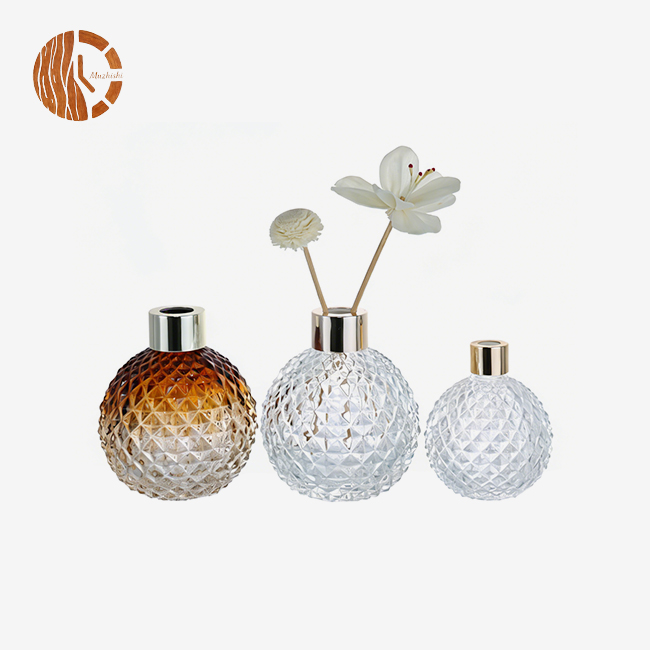
Blue goes well with clean, fresh, and aquatic scents, and gradation blue is the one we usually use. Warm, woodsy, spicy, or oriental themes go well with amber and gold fades. Pink, rose, and lavender are good colors for floral or romantic lines. Black, purple, and burgundy are good colors for evening, niche, or limited-edition lines. We can make custom colors that are exactly Pantone matched if you want a color that isn't on this list. The final choice should be based on market research, since people in different parts of the world read colors in different ways. Before you approve the sample, I always say to look at it in both store lighting and daylight.
Size, Shape, and Cap Choices
Our gradient bottles come in 6 ml and 7 ml sizes, which are good for travel sizes, samples, discovery sets, and small perfume or serum lines. You can choose from square, round, or custom shapes. Making things with cylindrical or rectangular shapes is usually easier than making things with sculptural shapes. The screw-on caps can be gold, silver, white, black, or any color you want. The bottle has a pump sprayer. Finish is also important. A matte gradient hides fingerprints and feels more understated, while a glossy gradient shines more and looks brighter.
Decoration and Packaging Options
When the gradient is dry, a third layer of ornamentation can be added. This can be done by laser etching, hot stamping or screen printing. We also do internal engraving, clear lacquer, and can place labels or stickers on things. You can alter the form, size, color and kind of cap to suit your design. If you need a certain bottle shape, we can 3D print prototypes before we make the mold, so your design and packaging engineering teams can immediately inspect the shape. You can buy unique packaging boxes for selling products or giving gifts. Our ODM design team can even create their own concepts based on what you tell them and who you want to reach.
How Gradient Color Is Applied and Checked
Our Production Steps
Each gradient has an order. We manufacture our own bottles in furnaces with 150 tons of glass apiece. Then the bottles go through an annealing lehr to reduce stress in the bottles. Followed by an initial check of their look and size. After cleaning and deionizing, the robots apply the lacquer or PVD coating, in a regulated region. Then the coating is baked in an oven to ensure it sticks well. Then after final inspection and packing to your requirements the decoration will take place. By looking at the processes in order we can see why we don't have to treat each batch as a fresh experiment each time we receive the same result.
Quality Tests Before Shipment
The following checks are done on each batch.
| Test | Method or condition | What it confirms |
|---|---|---|
| Color consistency | Spectrophotometer, ΔE below 1.0 | Same shade and transition point across a batch |
| Coating adhesion | ISO 2409 cross-cut; 24 hours in 96% ethanol | Coating stays intact if fragrance touches it |
| Abrasion resistance | RCA testing, over 200 cycles | Resists wear from handling, handbags, and pockets |
| Thermal shock | Cycles between 0°C and 60°C | No cracking or delamination |
| Vacuum leak test | Applied to the sealed neck finish | Safe transit and storage |
The spray stage works in Class 10,000 cleanrooms that are filtered, which keeps dust in the air and problems with surface texture to a minimum.
Keeping Batch Color Consistent
Design-led brands are mostly concerned about batch-to-batch color variances, and rightly so. We reply in three sections. First, the Pantone reference and accepted master sample establish the target. Second, six-axis robots repeat the same spray route and spectrophotometer readings indicate that each batch remains below ΔE 1.0. Third, the change point must be the same for all units of the same order. The letter Δ stands for "color difference," so it gives you and me a number that we can both use in perfume bottle design. I think you should ask any source for measured data, not a comparison.
How to Select and Buy Gradient Perfume Bottles?
Build a Clear Specification
Before you request quotes, please write down the bottle material, size, form, gradient reference, finish, neck size, closure type (pump or closure), cap color, logo method, packing method, quantity and delivery date. Separate the unchangeable things from the items that are only a matter of personal preference. Then you can choose stock, semi-custom or entirely custom. Stock shapes are faster to produce and use less tooling than bespoke shapes, while custom shapes are preferable for long-term ownership. Once you approve the physical sample in different lights, evaluate the spray performance and leakage and compatibility with the recipe before you make a lot of it.
Working With a Manufacturer
Because shaping, coating, and decorating all happen in the same place, a direct manufacturer can give more clear technical answers. Since 2005, Xuzhou Muzhishi Crafts Co., Ltd. has been making glass packaging. They offer ODM and OEM service and each customer has their own account manager. You can get free samples in 3–5 days, which lets you get an idea of the color and feel right away. We have the right to import and export goods on our own, and we make commercial invoices, packing lists, and certificates of origin that meet the customs requirements of each destination. Response time after the sale is 24 hours.
Cost, MOQ, Lead Time, and Risk
The cost is based on the amount, weight, complexity of the mold, decoration method, color count, closure material, quantity, and testing of the glass. I'm not going to give numbers here, but you might want to write these things down to be sure.
| Item | What to confirm |
|---|---|
| MOQ | Separate minimums for stock bottles, custom colors, custom molds, and components |
| Tooling | Whether a new mold fee applies and whether 3D prototypes come first |
| Sampling | Timing and who approves color |
| Lead time | Color approval, pilot run, bulk production, and freight |
| Risk | Test records, packing method, and breakage protection |
Most projects go through a color draft, a process sample, color approval, a small batch, and a bulk order. You should allow extra time for custom molds, seasonal launches, and shipping goods overseas.
Conclusion
For high-end fragrance firms to stand out, a gradient color perfume bottle is useful. That color change provides the goods a unique appeal on the shelves and in images. Plus, it protects UV sensitive compounds from light, and allows multiple SKUs to fit into one shape. The end result depends on the process chosen, which could be spray coating, PVD or vacuum metallization. The product is decorated and tested. The biggest concern purchasers have is consistency of batches. All of this is done by the spectrophotometer ΔE control, adhesion, abrasion, thermal stress and leak tests. You need gradient glass to get more depth of color than the transparent, frosted, or acrylic alternatives. But it needs a precise requirement, an approved master sample and a realistic amount of time for MOQ, tooling and lead time. The safest bet is to pick a provider on the basis of quality control, rather than appearance alone.
FAQ
What sizes and colors are available?
It comes in both 6 ml and 7 ml bottles. Gradient blue is standard, and we can make custom colors that match Pantone. You can get caps in gold, silver, white, black, or any color you want.
Can the gradient protect my formula from light?
UV-sensitive formulations can be protected by light-blocking density that can be changed. Still, I think you should test your own liquid in a small bottle before making a lot of it.
How do you control color differences between batches?
We use a spectrophotometer to check each batch at ΔE below 1.0, and the point where the colors change must be the same from one unit to the next within the same order. You first sign off on a physical master sample.
Are samples available?
Yes. You can get samples for free, and they can be ready in 3–5 days. Before tools are made, 3D-printed prototypes can be used to start building custom structures.
Is the MOQ the same for every project?
No, the minimums for stock bottles, custom colors, molds, and parts can be different. Send us your specifications, and we'll make sure they are correct.
Request a Gradient Color Perfume Bottle Sample or Quotation
A gradient color perfume bottle launch is planned. Muzhishi makes gradient color perfume bottles for skin care and fragrance brands. They offer free samples, colors that match Pantone, and support for ODM and OEM orders. Email long@muzhishi.com with your capacity, colors, shape references, quantity, and where you want the goods to go. Read more at mzsglass.com, and our team will get back to you with samples, information on the minimum order quantity, and a quote that is tailored to your project.

References
1. ISO 2409:2020, Paints and Varnishes — Cross-Cut Test, 2020
2. CIE 142-2001, Improvement to Industrial Colour-Difference Evaluation, 2001
3. Handbook of Physical Vapor Deposition (PVD) Processing, 2010
4. Handbook of Cosmetic Science and Technology, 2014
5. Essential Oil Safety, 2014
6. ASTM D3359, Standard Test Methods for Rating Adhesion by Tape Test, 2023

Our customers’ satisfaction speaks for our quality — contact us to experience the same reliable service.