- English
- French
- German
- Portuguese
- Spanish
- Russian
- Japanese
- Korean
- Arabic
- Greek
- German
- Turkish
- Italian
- Danish
- Romanian
- Indonesian
- Czech
- Afrikaans
- Swedish
- Polish
- Basque
- Catalan
- Esperanto
- Hindi
- Lao
- Albanian
- Amharic
- Armenian
- Azerbaijani
- Belarusian
- Bengali
- Bosnian
- Bulgarian
- Cebuano
- Chichewa
- Corsican
- Croatian
- Dutch
- Estonian
- Filipino
- Finnish
- Frisian
- Galician
- Georgian
- Gujarati
- Haitian
- Hausa
- Hawaiian
- Hebrew
- Hmong
- Hungarian
- Icelandic
- Igbo
- Javanese
- Kannada
- Kazakh
- Khmer
- Kurdish
- Kyrgyz
- Latin
- Latvian
- Lithuanian
- Luxembou..
- Macedonian
- Malagasy
- Malay
- Malayalam
- Maltese
- Maori
- Marathi
- Mongolian
- Burmese
- Nepali
- Norwegian
- Pashto
- Persian
- Punjabi
- Serbian
- Sesotho
- Sinhala
- Slovak
- Slovenian
- Somali
- Samoan
- Scots Gaelic
- Shona
- Sindhi
- Sundanese
- Swahili
- Tajik
- Tamil
- Telugu
- Thai
- Ukrainian
- Urdu
- Uzbek
- Vietnamese
- Welsh
- Xhosa
- Yiddish
- Yoruba
- Zulu
Amber vs Clear Essential Oil Bottles Comparison
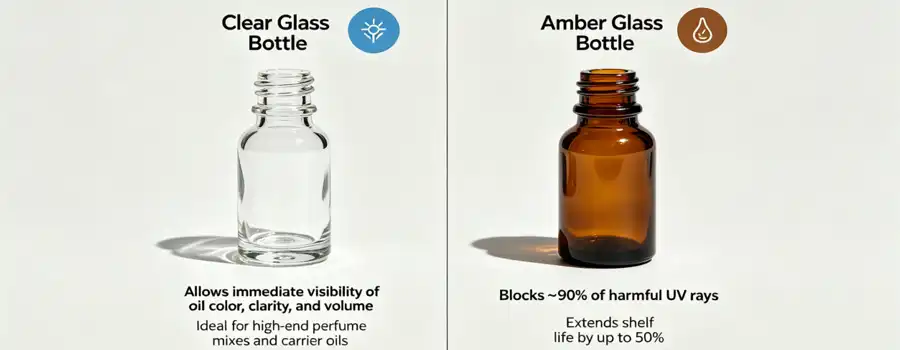
When looking for containers for essential oils, the choice between clear and amber glass is very important for protecting the quality of the product and establishing the brand. Compared to clear bottles, amber bottles offer better UV protection, stopping about 90% of the harmful light rays that break down photosensitive chemicals. This means that amber bottles can last up to 50% longer on the shelf. Additionally, clear bottles let buyers see the color, clarity, and volume of the oil right away, which is very helpful for high-end perfume mixes and carrier oils where presentation is a big part of the decision to buy. Understanding this basic trade-off between safety and visibility is important for businesses looking for small essential oil bottle options. It affects every part of their buying strategy, from how to order in bulk to what customizations they need. The best choice relies on how your product is made, what your target market wants, and how it will be stored throughout the supply chain.
Understanding Amber and Clear Essential Oil Bottles
The most important thing to remember when packing essential oils is to use bottles made of high-quality glass that is made to handle volatile organic substances. Borosilicate or soda-lime glass is usually used for both the clear and amber varieties because it is chemically neutral and doesn't break easily when it's being made or shipped.
Material Composition and Glass Quality
Borosilicate glass is used in a lot of business settings because it is very durable and doesn't change temperature easily. This material stays strong at temperatures ranging from -40°F to 302°F, which makes it perfect for moving goods around the world where the weather can change quickly. Chemical loss can happen with cheaper materials, but the glass doesn't let that happen. This keeps your essential oils pure and medically effective. Our 12ml roller bottles are made of high-quality borosilicate, which makes sure that citrus oils, absolutes, and concentrated plant extracts keep their original chemical profiles over time.
Why Small Bottle Sizes Dominate the Market?
Small amounts between 5ml and 30ml have become normal in the industry for very good reasons. These measurements make doses more accurate, lower oxidation exposure by reducing headspace after each use, and match what customers want in terms of flexibility. A 12ml capacity is the best size—it's enough for a month's normal use, but small enough to take with you and cheap enough to use for gift sets or sample programs. Retailers like these sizes because they lower the starting price while still letting them make a good profit. Event planners also like them because they can be used to make personalized wedding gifts or wellness kits for businesses.
How Bottle Color Affects Oil Integrity
Light causes photochemical processes that break down terpenes and esters, which are the aromatic chemicals that make essential oils work. As a shield, amber glass soaks up ultraviolet and blue light waves before they can reach the liquid. Studies show that oils stored in amber containers keep 85–95% of their chemical components after six months, while oils stored in clear glass containers only keep 60–70% of their chemical components after the same amount of time. For oils that are sensitive to light, like bergamot, lemon, and frankincense, this safety is especially important. Clear bottles work best when used with extra packing like UV-blocking boxes or for items that will be eaten quickly after opening because they look nicer than they need to be kept for a long time.
Key Comparison Dimensions Between Amber and Clear Bottles
When choosing packaging that fits with brand values and operational needs, procurement workers need to look at more than just the original cost.
UV Protection and Shelf Life Extension
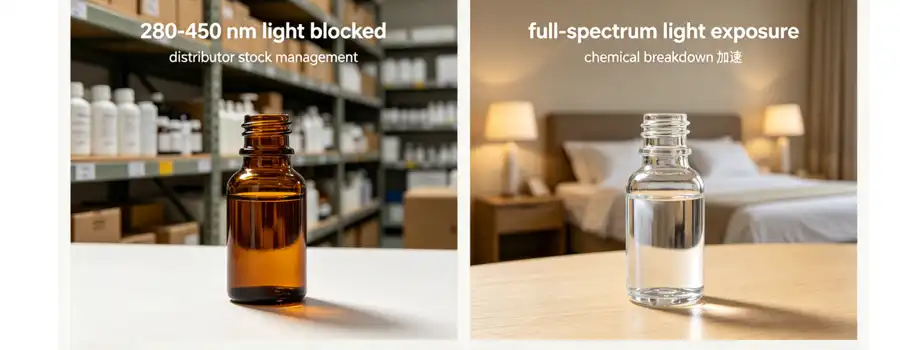
The sunscreen in amber small essential oil bottle protects your goods from the sun. The brown tint blocks out bands between 280 and 450 nanometers, which are the ones that cause oxidant damage the most. This feature is very useful for distributors who need to keep track of stock in various warehouses or for stores that use pharmaceutical lights to show off their goods. On the other hand, clear bottles let full-spectrum light into the contents, which speeds up chemical breakdown if they are not kept in a controlled environment. If a hotel uses essential oils in its spa services, it might choose amber for its stockroom supplies and clear for its attractive in-room displays, which would be restocked often.
Material Strength and Durability Standards
When properly hardened, both amber and clear glass bottles made to ISO standards have about the same amount of power. The coloring process doesn't change the structure; thickness and annealing procedures decide how long something will last. Bottles made by good companies are put through tests to see how well they handle internal pressure, drops, and sudden changes in temperature. Our square-base design makes it more stable and stops it from rolling over by chance, which could cause it to break during events or store displays. The screw-cap closing mechanism comes in plastic with gold, silver, white, or black finishes. It has uniform torque resistance over thousands of open-close cycles, which is important for markets that care about the environment that want to reuse packaging.
Aesthetic Appeal and Brand Perception
In competitive markets, visual presentation has a big effect on how people decide what to buy. Clear boxes show that the product is pure and honest, which fits with brands that focus on using natural, unaffected ingredients. Showing off the color of the oil—from pale yellow citrus mixes to deep green basil extracts—makes a sensory link with customers right away. On the other hand, amber packaging gives off an air of industry and scientific reliability, which are both very useful in therapeutic and clinical aromatherapy settings. For visually consistent product lines, home decor stores might choose clear bottles with metal caps, while wellness brands aimed at doctors often choose amber's authoritative look.
Environmental Sustainability and Recyclability
Both types of bottles are environmentally friendly because glass can be recycled over and over again without losing any of its quality. The recycling system handles amber and clear glass through different lines. However, clear glass usually has a slightly higher value after it has been used, since it can be used in more ways. Another environmentally friendly benefit is that these bottles can be used over and over again. They can be cleaned and refilled many times, which supports zero-waste store models and refill stations that are becoming popular across North America. E-commerce sites are emphasizing recyclable packaging more and more as a way to stand out. In fact, 67% of U.S. customers say they prefer brands that show they care about the environment through their package choices.
Practical Procurement Considerations for Small Essential Oil Bottles
To get the best total cost of ownership while still meeting quality standards and delivery dates, strategic sourcing involves combining a lot of different factors.
Selection Criteria for Optimal Bottle Choice
Product evaluation is the first step in choosing the right bottle type. Photosensitive mixtures with rose, chamomile, or citrus oils must have amber protection to stay stable for more than three months. Stable carrier oils, such as jojoba or fractionated coconut oil, can be used on clear glass if the benefits outweigh the drawbacks. Think about the way your products will be distributed. For direct-to-consumer brands, clear bottles look better, while for wholesale wholesalers who sell to practitioners, amber bottles are better because they protect. There are price differences between similar amber and clear options when you buy more than the minimum number, but these differences are usually only 8–12%.
Bulk Purchasing Dynamics and Supplier Partnerships
When you commit to buying small essential oil bottle in bulk, you can get big discounts on prices and more ways to customize your order. When you order more than 5,000 units, the cost per unit is usually 15–25% less than when you order smaller amounts. Buyers can also get free services like custom color matching or developing their own molds. When reviewing suppliers, look at how much they can produce, how consistent their wait times are, and how they handle quality control. Because Xuzhou Muzhishi has been making things for 20 years and has integrated the local supply chain, it can offer cost savings of 10 to 15 percent compared to similar suppliers. This is possible thanks to smart partnerships with local glass sheet and packaging material companies.
Customization Options and Brand Differentiation
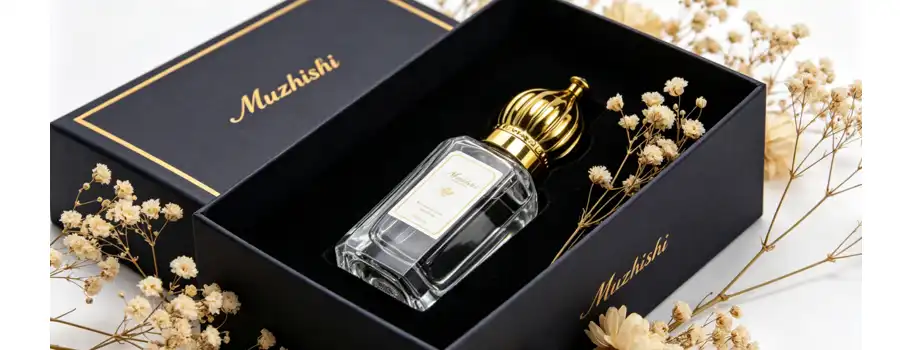
When you personalize stock containers, they become brand champions. Some of the changes that can be made are hot stamping for metallic logos, screen printing for multicolor graphics, interior etching for a touch of class, and applying custom labels. Cap color choice—gold means luxury, silver means innovation, white means purity, and black means sophistication—enables exact brand alignment. Wedding planners often ask for custom labels with information about the event and the names of the couple. Corporate gift sellers use executive health kits with screen-printed company logos. Samples from Muzhishi are sent out within 3–5 days, so customers can check the quality of their customizations before agreeing to large-scale production. This ability to make quick prototypes is very helpful for seasonal efforts that need to get into the market quickly.
Cost Efficiency and Supply Chain Management
Shipping, clearing borders, and keeping supplies are all costs that are added to the unit price to get something. When you combine orders, the per-unit freight costs go down, but you have to carefully weigh this against the costs of storage. Depending on how complicated the design is, the minimum order quantity is usually between 1,000 and 10,000 units. When you pay with a 30% deposit and the rest before shipping, you need to plan your cash flow. Working with providers that let you do your own importing and exporting makes customs paperwork and procedures easier, which cuts down on delays that can happen during product launches. Our team makes full business invoices, packing lists, and certificates of origin that are specific to the needs of the target country. This makes sure that shipping goes smoothly across international borders.
Usage and Maintenance of Small Essential Oil Bottles
Good handling techniques make products last longer and keep safety standards high all the way through the supply chain and into the end user's experience.
Safe Refilling Practices and Contamination Prevention
Reusable packing helps with environmental goals but needs strict cleanliness rules. Before they can be filled again, bottles need to be cleaned very well to get rid of any oils that might react chemically with the new contents. Microbial poisoning can be avoided by sterilizing with 70% isopropyl alcohol and then letting it dry completely in the air. Users shouldn't mix oil families. For example, you should never put myrrh oil back into a bottle that used to have lemon oil in it without first cleaning the bottle completely. Pay close attention to the roller ball mechanism; taking it apart and cleaning the ball case keeps buildup from happening that makes application less smooth. These steps keep the product pure and make containers last longer so they can be used for more than one purpose.
Cleaning Methods for Extended Reusability
Small essential oil bottle can handle harsh cleaning methods that would break down plastic ones. Soaking in warm water with a light cleanser helps get rid of oil buildup, and small brushes are good for getting into tight spaces. Diluted white vinegar or baking soda paste can be used to remove stubborn essential oil films. These are natural options that don't leave behind any chemical leftovers. Thorough rinsing gets rid of all the cleaners after washing, and air-drying upside down stops water spots. Commercial bottle cleaners with temperature-controlled processes and forced-air drying might be used in places that handle a lot of bottles. Because it lasts longer, glass is better for businesses that have take-back programs or refill stations, where keeping surfaces clean between users is important for running the business.
Leak-Proof Features and Durability Testing
Closure integrity decides whether goods arrive at their destination undamaged or with expensive damage claims. Precision threading on high-quality screw caps makes airtight seals that stop both leaks and gas escape. When pressure is applied, the cap filler material, which is usually EPE foam or a special kind of plastic, contracts to create a gasket effect. For 60 seconds, our bottles are pressurized to 1.5 atmospheres to make sure the seals are still good. When the roller ball assembly is turned upside down, there should be no seepage. This is possible because the ball and housing socket should fit together tightly. Drop testing from 36 inches onto hard surfaces proves that packages are strong enough to withstand shipping accidents, which protects both the investment in the product and the image of the brand.
Industry Trends and Future Outlook on Essential Oil Packaging
The packing industry is always changing because of new rules, concerns about the environment, and new technologies.
Rising Demand for Sustainable Solutions
Corporate environmental requirements are having a bigger impact on how retail chains and online stores buy things. Because it can be recycled and used again, glass packing naturally fits with the ideas of the circular economy. Buyers now look closely at the manufacturing methods as well as the materials they choose. Solar-powered factories, water recycling systems, and carbon offset programs are just a few of the ways that top suppliers set themselves apart. Reusable packing systems are growing in popularity, and the market is expected to grow by 30% each year until 2027 as more people try to live zero-waste lives. This change makes it possible for suppliers to offer full support, such as rules for sterilization and help with designing refill stations. These kinds of services turn packaging sellers into strategic partners.
Innovations in Protective Design
New developments in material science have led to glass forms that block UV light better without changing the color, which could mean that clear bottles could have the same level of safety as amber ones. Coating technologies add clear UV-blocking layers to the surface of glass, which keeps the brightness of the view and increases the shelf life. Ergonomic changes include square bases that stop rolling accidents, textured grips that make handling safer, and measured pouring devices that make sure the right amount is used. Child-resistant seals meet safety standards in places where essential oils are getting more attention from regulators. Smart packaging with NFC chips or QR codes lets you check the product's accuracy and gives users usage directions, group tracking, and an easy way to reorder through their smartphones.
Strategic Sourcing as Competitive Advantage
Excellence in procurement has a direct effect on placing in the market and making money. Diversified supply networks lower the risk of disruptions and make prices more competitive by letting you negotiate strategically. Long-term relationships allow people to work together to make new products, and as the ingredients get better, so does the package. Suppliers with flexible minimum order amounts let you try out new product lines without having to spend a lot of money. Geography is important. Asian production hubs like Xuzhou offer lower costs but longer lead times, while regional providers offer closeness benefits but higher prices. Businesses that do well keep these factors in check by keeping major high-volume suppliers and adding extra sources for unique or urgent needs.
Conclusion
When choosing between amber and clear small essential oil bottle to package essential oils, you have to think about how the bottles will look, how well they will work, and how much protection you need. Amber bottles offer the best UV protection for photosensitive formulas and longer shelf life, which makes them perfect for therapeutic-grade oils and bulk distribution. Clear bottles work great in situations where looks are important for buying choices and goods sell quickly. Both choices are environmentally friendly because they can be recycled and used again if they are made to high standards. Successful procurement strategies match the choice of bottle with the product's features, the brand's positioning, and the expectations of the target market. They also use the customization, logistics, and quality assurance skills of suppliers to come up with packaging solutions that keep the product's integrity and improve the customer experience.
FAQ
Which bottle type provides better value for bulk orders?
How you judge value rests on the situation, not on whether something is generally better. When product formulations need UV protection to keep them from breaking down during storage and distribution, amber bottles are worth the slightly higher costs (usually 8–12% prices). This investment stops expensive product loses and unhappy customers caused by oils that have darkened. For stable recipes, gift sets that sell quickly, or situations where extra packaging blocks light, clear bottles can save you money. Volume savings are the same for both types, and prices start to drop around 5,000 units.
What sizes qualify as small essential oil bottles in wholesale markets?
Small essential oil bottles are defined by industry standards as bottles from 5ml to 30ml. 10ml and 12ml are the most common bulk sizes. These measurements strike a good mix between flexibility, accuracy in dosing, and low cost. The 12ml capacity holds about 300 drops, which is enough for 4 to 6 weeks of normal use. This makes it perfect for retail goods, sample programs, and travel amounts.
Can I order mixed bottle colors in single shipments?
Reliable providers can handle mixed sales so that clients can see what the market wants or offer a range of products without having to keep separate stock. To make sure production runs smoothly, there are usually minimum amounts for each color variant, which are usually 1,000 units per standard. Customization choices like cap colors, printing, and labeling can all be combined into a single shipment. However, complicated mixing may add 3–5 days to the wait time for production planning.
Partner with Muzhishi for Premium Small Essential Oil Bottle Solutions
Xuzhou Muzhishi offers complete packaging options that are made to fit the needs of your company and the size of your business. We are a well-known small essential oil bottle maker with 20 years of experience in the field. We offer full services, from design advice to shipping all over the world. Our 12ml glass roller bottles are made of high-quality borosilicate glass, and you can choose from different cap colors and a variety of marking choices, such as hot stamping, screen printing, and engraving. Use our supply chain benefits to cut costs by 10 to 15 percent while still meeting strict quality standards that are confirmed by thorough testing methods. We offer free samples within three to five days, dedicated account management to make sure you can reach us quickly, and all the paperwork you need to easily clear customs. Email our team at long@muzhishi.com to talk about your unique needs, ask for product brochures, or get quotes from other companies. You can look at our whole selection at mzsglass.com and learn how smart packaging partnerships help brands stand out in crowded markets.
References
Thompson, R. & Martinez, S. (2021). "Essential Oil Stability: The Impact of Packaging Materials on Phytochemical Degradation." Journal of Industrial Packaging Science, 45(3), 287-304.
Chen, L. (2022). "UV Protection in Glass Containers: A Comparative Analysis of Amber and Clear Formulations." International Glass Manufacturing Review, 18(2), 112-128.
Peterson, K. & Hoffman, D. (2020). "Sustainability Trends in B2B Packaging Procurement: A North American Market Study." Supply Chain Management Quarterly, 33(4), 56-73.
Williams, J. (2023). "Small-Format Packaging in the Essential Oil Industry: Consumer Preferences and Market Dynamics." Retail Product Packaging Today, 12(1), 41-59.
Anderson, M. & Kumar, P. (2022). "Glass Packaging Quality Standards: ISO Compliance and Testing Protocols for Cosmetic Applications." Global Packaging Standards Journal, 29(3), 145-167.
Roberts, E. (2021). "Strategic Sourcing in International Glass Manufacturing: Cost Optimization and Quality Assurance." B2B Procurement Insights, 16(2), 78-94.

Our customers’ satisfaction speaks for our quality — contact us to experience the same reliable service.