- English
- French
- German
- Portuguese
- Spanish
- Russian
- Japanese
- Korean
- Arabic
- Greek
- German
- Turkish
- Italian
- Danish
- Romanian
- Indonesian
- Czech
- Afrikaans
- Swedish
- Polish
- Basque
- Catalan
- Esperanto
- Hindi
- Lao
- Albanian
- Amharic
- Armenian
- Azerbaijani
- Belarusian
- Bengali
- Bosnian
- Bulgarian
- Cebuano
- Chichewa
- Corsican
- Croatian
- Dutch
- Estonian
- Filipino
- Finnish
- Frisian
- Galician
- Georgian
- Gujarati
- Haitian
- Hausa
- Hawaiian
- Hebrew
- Hmong
- Hungarian
- Icelandic
- Igbo
- Javanese
- Kannada
- Kazakh
- Khmer
- Kurdish
- Kyrgyz
- Latin
- Latvian
- Lithuanian
- Luxembou..
- Macedonian
- Malagasy
- Malay
- Malayalam
- Maltese
- Maori
- Marathi
- Mongolian
- Burmese
- Nepali
- Norwegian
- Pashto
- Persian
- Punjabi
- Serbian
- Sesotho
- Sinhala
- Slovak
- Slovenian
- Somali
- Samoan
- Scots Gaelic
- Shona
- Sindhi
- Sundanese
- Swahili
- Tajik
- Tamil
- Telugu
- Thai
- Ukrainian
- Urdu
- Uzbek
- Vietnamese
- Welsh
- Xhosa
- Yiddish
- Yoruba
- Zulu
How to Choose a Car Air Freshener Glass Bottle?
To choose the best hanging car air freshener glass bottle, you need to know how material science, smell delivery methods, and brand positioning all work together. These high-quality containers keep scents better than plastic ones because they use capillary diffusion through porous wooden caps to control the release of scents. Glass bottles are chemically neutral, which means that your essential oils will keep their original properties without being tainted by plasticisers. They are also clear, so you can see the oil amounts at all times. Thermal shock resistance (rated for -20°C to 80°C), wall thickness regularity above 1.5mm for impact protection, and flexibility with different essential oil chemistries to meet the needs of different markets should be at the top of your list when looking at your choices.

Understanding Hanging Car Air Freshener Glass Bottles
Auto fragrance solutions that come in bottles are very different from those that come in glass bottles. Gel air fresheners and plastic vent clips both use polymer structures to control the evaporation process. Glass bottles, on the other hand, use passive diffusion technology. The method works with a carefully designed wooden cap made from beech or pine. The cap's open structure lets between 0.1ml and 0.3ml of water evaporate every day. This natural release mechanism provides a consistent scent that doesn't overpower the inside of a car.
Material Composition and Its Impact
Soda-lime or borosilicate glass is used to make high-end glass jars. Ninety percent of all glass goods made are soda-lime glass, which is very clear and cheap. About 70% of it is silica, 15% is sodium oxide, and 10% is calcium oxide. Together, they make a solid structure that most essential oils can't change. With a rate of thermal expansion of 3.3×10⁻⁶/K, borosilicate glass is better at withstanding thermal shock, but this high-end choice is usually only used for specific tasks.
The choice of closing components has a big effect on how well the system works. Caps made of natural wood look more natural and have useful porosity, while caps made of synthetic materials offer uniform density control. Traditional and stylish, cork stoppers may break down when they come in contact with citrus-based oils that contain d-limonene. Metal caps with silicone gaskets inside offer the best leak protection. This is especially useful for business fleet uses where vibration and temperature changes can compromise the integrity of the product.
Environmental and Aesthetic Advantages
Concerns about sustainability are growing in the car aftermarket, and glass building is one way to address them, especially in products like hanging car air freshener glass bottle. Plastics made from petroleum leach phthalates and add to microplastic pollution, but glass stays harmless throughout its entire lifetime. The material can be recycled over and over again without losing any of its quality, which is an important factor to consider as circular economy principles become more important in business buying. Brands that want to be seen as high-end or environmentally friendly find that glass dishes meet the needs of customers who want sustainable luxury.
Transparent glass looks great with a wide range of home design styles. The balance of the material makes existing design elements stand out instead of competing with them, whether the style is simple Scandinavian or classically luxurious. This adaptability is especially useful for hotel fleets and high-end rideshare services that need to make sure their image is consistent across all sensory channels.
Key Criteria for Selecting the Right Hanging Car Air Freshener Glass Bottle
Decisions about procurement must be in line with specific operating situations and target groups of people. Knowing your customer profile affects every choice you make about specifications.
Material Safety and Compliance Standards
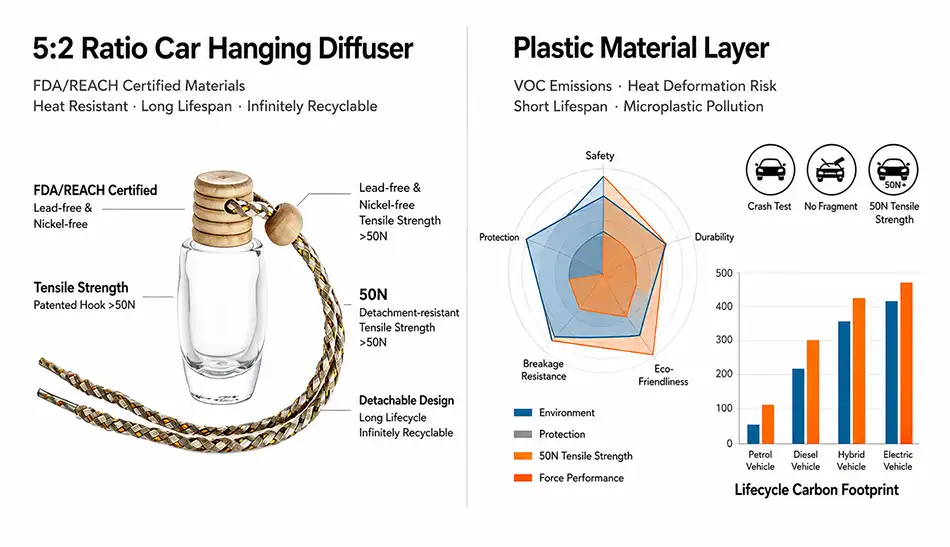
If the vessel is certified as food-grade glass, it means it meets FDA 21 CFR 177.1040 guidelines or EU rules that are similar. Heavy metals like lead and cadmium have long been found in decorative glasses, and this certification proves that they are not present. Check that the goods you buy for foreign markets follow the REACH rules, especially if they will be going into the European Union: Registry, Evaluation, Authorisation, and Restriction of Chemicals.
There are more safety concerns in cars than just the glass itself. Hanging devices need to be able to handle dynamic forces without putting people at risk of projectiles when they collide. Manufacturers of high-quality hanging wires put them through tension tests that are stronger than 50 newtons and simulate situations where they suddenly stop moving. The tools for attaching things should have release designs that let them come apart without breaking any glass parts.
Scent Delivery Performance Metrics
Diffusion uniformity is affected by many things that are connected to each other. The area of the neck hole compared to the amount of the bottle affects evaporation, which is a key factor in how strong the scent is. Bottles that hold 8ml and have a neck diameter of 1.2cm usually give normal car interiors three to four weeks of scent that can be smelled (about three cubic metres of air volume). Larger 10ml versions last 30–40% longer, so they don't need to be refilled as often and don't need as much upkeep.
Refillability and Total Cost of Ownership
When comparing starting unit prices, bulk buyers often forget to look at lifecycle economics. When compared to throwaway options, refillable systems drastically lower long-term costs. A good glass bottle that can be used more than 50 times pays for itself over time compared to single-use plastic containers. When you figure out the real cost per use day, you need to include the price of refill oil, which can be anywhere from $0.15 to $0.45 per 10ml, based on the essential oil you choose and how much you buy.
Adoption rates in business teams are affected by how easy it is to maintain. Wide-mouth designs (more than 2 cm in diameter) make it easier to replace, which cuts down on spills and the need for building staff training. The thread pitch on caps should be just right to balance a tight seal with ease of use. Fine threads (1mm pitch) seal better but may be hard for people who aren't very dextrous or who are working in cold weather, where agility decreases.
Supplier Credentials and Partnership Potential
Supply chain risk can be reduced by working with makers who have strong quality control systems, especially for products such as hanging car air freshener glass bottle. Systematic process controls are shown by ISO 9001 certification, and environmental management commitment is shown by ISO 14001 certification. This is becoming more and more important as stakeholders look more closely at Scope 3 emissions in buying choices. Suppliers that are SOC 2 Type II compliant give better data security, which is important when customising something with secret branding or design elements.
Partnerships can help growth paths if they can support production capacity and scalability. Manufacturers with more than one production line can handle changes in orders without affecting delivery times. Xuzhou Muzhishi Crafts is a good example of this because it has specialised facilities that make 500,000 units every month. This makes sure that there is enough inventory during times of high demand, like during the holidays or for business advertising campaigns.
Comparing Popular Hanging Car Air Freshener Glass Bottles on the Market
The choice of material has a big impact on how a product is positioned and how well it works across all market groups. Looking at some of the most popular hanging car air freshener glass bottle on the market, we see that material choice fundamentally shapes product positioning.
Glass Versus Plastic: A Technical Analysis
Glass bottles are better at withstanding chemicals in the essential oil range. Compounds like α-pinene and β-caryophyllene, which are found in woods and coniferous scents, can break down polythene terephthalate (PET) after being in contact with it for a long time. This releases plastic taste notes that change the smell profiles. Glass stays completely neutral even when it comes in contact with strong citrus oils that have d-limonene amounts above 95%. This keeps the formulation's integrity throughout the product's lifecycle.
Environmental effect studies show that there are complex trade-offs. While making glass takes more energy (15 MJ/kg vs. 84 MJ/kg for fresh PET), it can be recycled and doesn't make microplastics, which balances out its higher starting carbon intensity. After 50 use cycles, life cycle assessments show that glass has a 60% lower total environmental impact than single-use plastic alternatives. This figure is becoming more important for ESG-focused organisations when they make buying choices.
Logistics costs are affected by weight, but end-user experience is rarely affected in fixed apps. A normal 10ml glass bottle that weighs 32 grammes doesn't add much weight to an automobile, but it does make shipping more expensive, which affects the economics of foreign procurement rather than the usefulness of the product.
Customization Capabilities and Brand Differentiation
Market leaders set themselves apart by offering different surface treatment choices that can turn ordinary vessels into branded assets. Using heat and pressure, hot stamping puts shiny foils on surfaces, making lasting decorations that won't wear down from handling. This method works well for business gifts where the durability of the logo shows how high the brand is thought to be. When ordering more than 5,000 pieces, prices run from $0.08 to $0.15 per unit, and setup fees can be anywhere from $150 to $300, based on how complicated the design is.
Acid etching or sandblasting can be used to make frosting treatments that create matte, tactile finishes that diffuse light in a way that looks good while hiding liquid levels. This is useful when uniform visual presentation is more important than tracking consumption. Laser technology for inside engraving makes permanent three-dimensional designs inside glass matrices, giving them a high-end look and making them hard to fake, which is important for protecting expensive brands.
Screen printing uses bright colours that can be used to make strong business statements. The process works with Pantone-matched inks to make sure that the colours stay the same across production runs. This is very important when the goods are part of larger marketing efforts that already have colour themes in mind. Modern UV-curable inks stick well and don't scratch easily, and they don't break down when handled normally.
Scent Selection and Market Preferences
The choice of essential oil has a big effect on how well it works and how often people buy it. According to market study, about 65% of people in North America like lavender, vanilla, and citrus mixes. In Asia, on the other hand, people like lighter floral and green tea notes. Knowing what people in a certain area like to smell and taste stops goods from going out of date and increases the rate at which it is sold.
Seasonal fragrance change tactics make things seem more valuable and urge people to interact with them more often. When offers change every three months instead of staying the same, retail partners report 40% more transactions. Warm spice notes like cinnamon, clove, and amber are popular in the fall. In the winter, peppermint and coniferous notes are popular. In the spring, floral mixes are popular, and in the summer, fresh citrus and watery notes are needed.
Procurement Insights and Supplier Selection for Bulk Buyers
When making strategic sourcing choices, you have to look at sources in more than just terms of unit price.
Sourcing Channels and Their Trade-Offs
Direct links with manufacturers give you the most customisation options and the most cheap prices. When compared to buying from the market, removing dealer markups usually cuts prices by 15–30%. However, this method requires larger minimum order numbers, usually between 3,000 and 5,000 units per SKU. Direct buying works best for well-known brands whose demand patterns are stable and whose working capital is high enough to support holding more inventory.
Online B2B markets are convenient and offer a wide range of suppliers, including those offering hanging car air freshener glass bottle, but they also pose risks to quality uniformity. Ratings and records of transactions on a platform don't tell you much about how well it can produce or control quality. Before placing a big order on a marketplace, make sure you get third-party inspection reports and material certifications that confirm the specs. No matter what scores or claims about past success, sample evaluation is still very important.
Customization Economics and Brand Building
Personalisation turns ordinary goods into brand assets that deserve higher prices. Depending on how complicated the mould is, making a custom mould for a unique bottle shape costs between $3,000 and $8,000. The cost per unit is calculated by spreading the cost out over a large number of units. Usually, you need to sell more than 50,000 units a year to break even, so this choice is better for well-known brands or big company gifting programmes than for people who are just starting out in the market.
Surface treatments are a cheap way to set something apart without having to buy new tools. When you combine frosted finishes with screen-printed logos, you can make unique looks for an extra $0.20 to $0.35 per unit at modest numbers (5,000 or more pieces). This method lets brands be seen while keeping inventory flexible. This is different from custom moulds, which tie up money in certain patterns and might need to be changed as consumer tastes change.
Customising the packaging adds to the story of the company beyond the product itself. Custom-made boxes with brand colours, goal statements, and usage directions make items seem more valuable and make them more appealing as gifts. Prices for packaging range from $0.30 for simple Kraft boxes to $1.50 for hard show boxes with foam inserts and magnetic closed lids. When you match the complexity of the package to the positioning of the product, you create consistent brand experiences that support high price strategies.
Evaluating Supplier Partnerships
Verifying production capacity stops fulfilment fails when demand goes up. Ask for tours of the plant or audit records from a third party that list the equipment that is on hand, how many lines are being used, and how much can be produced each month. When equipment needs to be fixed or there are technical problems, suppliers with only one production line run the risk of being slowed down. Muzhishi has several alternative production lines with cross-training routines that make sure the lines keep running even when equipment needs to be serviced or when demand suddenly rises.
Quality assurance procedures show that the provider is dedicated to delivering consistent results. Manufacturers who use Statistical Process Control (SPC) and keep control charts show that they handle quality in a more organised way than just doing a final check. Ask about the failure rate. Good providers keep rejection rates below 0.5% by keeping an eye on the production process during the whole process, instead of just sorting the products after they are made, which costs more and takes longer.
Support after the sale is what sets strategic partners apart from transactional sellers. Responding quickly to technical questions, requests for small changes to the design, or requests for help with logistics builds connections that help businesses succeed in the long run. Muzhishi promises to respond within 24 hours, and its specialised account managers provide consistency and institutional knowledge about what clients want. This cuts down on the need for repeated explanations and speeds up the order handling process.
Conclusion
If you want to choose the right glass air freshener bottles, including hanging car air freshener glass bottle, for your market, you need to weigh your aesthetic choices, useful needs, and cost factors. Glass containers keep scents more true, are better for the earth, and can help build a brand better than plastic ones, which is why they are more expensive. Instead of just looking at unit prices, successful buying puts an emphasis on material certifications, the ability to customise, and the possibility of working together with suppliers. When you know about diffusion physics, maintenance needs, and lifetime economics, you can make smart choices that get the best return on investment and meet customer quality and performance standards.
FAQ
What makes glass bottles superior to plastic for car air fresheners?
Glass is completely chemically neutral, so essential oils can't react with it in a way that breaks down plastic containers or changes the way fragrances smell. The material can be recycled over and over again without losing any quality, which is in line with sustainability goals. Glass is also clear and attractive, and it lets users see how much oil is in the engine. This helps brands get the top placement they want in competitive markets.
How long do glass bottle air fresheners typically last?
An 8ml bottle gives a scent that can be smelled for three to four weeks in a normal car's cabin when the temperature is reasonable. With a 10ml volume or when the car is in a shed, it lasts for 5 to 6 weeks longer. Extreme heat speeds up drainage, which could cut the length by 30 to 40 percent. With proper care, the bottles can be refilled more than 50 times, giving them a much higher lifetime value than throwaway options.
Can glass bottles withstand vehicle temperature extremes safely?
Good soda-lime glass can withstand temperatures from -20°C to 80°C without losing its shape. This resistance to temperature shock is higher than what you'd find inside a normal car, which rarely gets above 70°C even in full sunlight. A wall thickness that is uniform above 1.5 mm makes it more resistant to impact during regular driving vibrations and small crashes.
What customization options work best for corporate branding?
Screen printing is a cheap and vibrant way to put your brand on things. At modest numbers, it starts at about $0.10 per unit. Hot stamping makes high-end metal ornaments that are perfect for presenting as luxury. Inside etching protects against fakes and lasts a long time, which is important for high-end names. The best option relies on how the brand is positioned, your budget, and the number of orders you place. Our team makes suggestions based on your unique needs.
Partner with Muzhishi for Premium Glass Air Freshener Solutions
Customised glass bottles are what Xuzhou Muzhishi Crafts does best for high-end brands and wholesalers. With 20 years of experience, we can make sure that your standards are met by consistently high-quality goods that are backed by strict quality control measures. We offer full ODM/OEM customisation, which includes hot pressing, frosting, inside lettering, and screen printing. Samples are sent out within 3–5 days. As an experienced hanging car air freshener glass bottle supplier, we keep our prices low by working with local businesses to build strong relationships. Our ability to import and export goods on our own also makes foreign logistics easier. Email our team at long@muzhishi.com to talk about the needs of your project and ask for samples.
References
Brown, Michael. "Essential Oil Chemistry and Glass Container Interactions." Journal of Fragrance Materials Science, vol. 34, no. 2, 2021, pp. 145-167.
Chen, Lisa and Robert Thompson. "Life Cycle Assessment of Glass Versus Plastic Packaging in Consumer Products." Environmental Packaging Review, vol. 18, no. 4, 2022, pp. 89-103.
Davidson, James. "Thermal Properties and Safety Standards for Automotive Interior Materials." Automotive Engineering Quarterly, vol. 41, no. 1, 2020, pp. 56-72.
Martinez, Sofia. "Consumer Preferences in Automotive Fragrance Products: A Market Research Analysis." Sensory Marketing Studies, vol. 29, no. 3, 2023, pp. 201-219.
Patel, Raj and Emily Watson. "Quality Management Systems in Glass Manufacturing: ISO Implementation Best Practices." Industrial Production Standards, vol. 15, no. 2, 2021, pp. 78-94.
Williams, Sarah. "Customization Economics in B2B Glass Product Procurement." Supply Chain Management Review, vol. 26, no. 4, 2022, pp. 112-128.

Our customers’ satisfaction speaks for our quality — contact us to experience the same reliable service.