- English
- French
- German
- Portuguese
- Spanish
- Russian
- Japanese
- Korean
- Arabic
- Greek
- German
- Turkish
- Italian
- Danish
- Romanian
- Indonesian
- Czech
- Afrikaans
- Swedish
- Polish
- Basque
- Catalan
- Esperanto
- Hindi
- Lao
- Albanian
- Amharic
- Armenian
- Azerbaijani
- Belarusian
- Bengali
- Bosnian
- Bulgarian
- Cebuano
- Chichewa
- Corsican
- Croatian
- Dutch
- Estonian
- Filipino
- Finnish
- Frisian
- Galician
- Georgian
- Gujarati
- Haitian
- Hausa
- Hawaiian
- Hebrew
- Hmong
- Hungarian
- Icelandic
- Igbo
- Javanese
- Kannada
- Kazakh
- Khmer
- Kurdish
- Kyrgyz
- Latin
- Latvian
- Lithuanian
- Luxembou..
- Macedonian
- Malagasy
- Malay
- Malayalam
- Maltese
- Maori
- Marathi
- Mongolian
- Burmese
- Nepali
- Norwegian
- Pashto
- Persian
- Punjabi
- Serbian
- Sesotho
- Sinhala
- Slovak
- Slovenian
- Somali
- Samoan
- Scots Gaelic
- Shona
- Sindhi
- Sundanese
- Swahili
- Tajik
- Tamil
- Telugu
- Thai
- Ukrainian
- Urdu
- Uzbek
- Vietnamese
- Welsh
- Xhosa
- Yiddish
- Yoruba
- Zulu
How to Choose The Perfect Honey Jar for Your Business?
To choose the right honey jar, you should first know what kind of business you run and who you want to sell to. For retailers, gift shops, and hospitality businesses, round honey jars, especially those made from high-quality food-grade glass, offer exceptional flexibility. Several things affect the choice: how long the material will last, how well it fits with your other products, how customizable it can be to make your brand stand out, and how reliable the source is to make sure the quality is always the same. Glass cylindrical cases keep honey's natural properties better than any other material and make it easier for picky customers to see what's inside. When procurement teams look at different packaging choices, they have to balance how nice the packaging looks with how well it works, like making sure it doesn't let air in or out and working with automated filling lines to keep the product safe and the process running smoothly.

Understanding the Key Criteria for Choosing Round Honey Jars
Defining Your Business Needs and Usage Scenarios
Whether you're supplying small stores, fulfilling business gift contracts, or stocking supermarket chains, your packaging needs will be very different. Retail stores want jars with customizable surfaces that tell brand stories, while wholesale sellers want jars that can be stacked to save space in warehouses and money on shipping. For OEM relationships to work, production needs to be scalable and the minimum order quantity can be changed. For private labeling, on the other hand, logos and color changes need to be made quickly.
Every choice you make in the procurement process will depend on how well you understand these differences. Based on your volume estimates, you can decide if you need standard 500ml containers or a range of sizes to fit different types of honey. Material choice is affected by how often it will be used. For example, products used every day in hospitality settings need glass that doesn't chip, while limited-edition seasonal items can put more emphasis on looks over tough longevity.
Evaluating Material Quality and Airtightness
The type of glass directly affects how well honey stays fresh over long periods of time. Food-grade soda-lime glass with little iron keeps its visual clarity, which shows off the quality of the product, without turning yellow like lower-grade materials do. Wall thickness consistency, which is usually kept within a ±0.5mm range, stops structural weaknesses that could cause the piece to break during filling, capping, or transport. This precise engineering supports vertical load capacities of up to 45 to 60 psi, which is necessary for palletizing items on multiple levels in delivery centers.
Honey is kept from absorbing water and oxidizing, which change the taste and speed up the crystallization process, by airtight closing mechanisms. The jar's neck finish, whether it's a continuous thread or a lug-style, needs to be perfectly lined up with the closing system. To make sure the seal works in real life, good providers put samples through thermal shock tests that involve temperature differences of more than 42°C. The polarized light analysis shows internal stress patterns that show early failure, and the migration testing proves that the product meets California Prop 65 and EU standards for no chemical leaching into acidic honey environments.
Prioritizing Eco-Friendly and Reusable Options
As corporate clients demand verifiable environmental promises, sustainability credentials become more important in B2B buying decisions. Round honey jars can be recycled naturally, and choices for post-consumer recycled content lower carbon footprints without affecting the performance of the material. Plastic alternatives break down after many sterilization cycles, but glass stays strong after many washing and refilling processes, which supports circular economy efforts in store and hospitality refill programs.
Supplier certificates are written proof that a company is environmentally friendly. The ISO 14001 environmental management systems show organized ways to cut down on waste and energy use in production. Scope 3 emissions are being looked at more closely in business sustainability reports. To deal with them, carbon-neutral shipping options and regional production facilities that cut down on transportation distances are needed. These points are especially important for home decor and gift companies that want to sell their goods to high-end eco-conscious customers.
Round Honey Jars vs Other Shapes: Which One Fits Your Business?
Aesthetic Appeal and User Experience
The classic beauty of cylindrical containers doesn't change with the seasons. This makes them useful for a wide range of products, from traditional wildflower honey to newer types with added ingredients. The 360-degree symmetry makes the name look the same no matter which way the shelf is facing. This gets rid of the "dead zones" that come with hexagonal or square designs. This geometric uniformity makes automated labeling easier, which lowers the number of times labels get misaligned on high-speed packaging lines and lowers the costs of doing business for companies that make a lot of labels.
From the customer's point of view, the curved outside fits easily in the hand and makes pouring and serving easy. When guests handle containers directly in a hospitality setting, the lack of sharp edges makes the area safer. Planners of events like how round jars work well with centerpieces and dessert displays. Their classic shape also goes well with both rustic farming styles and the minimalist modern styles that home decor brands like.
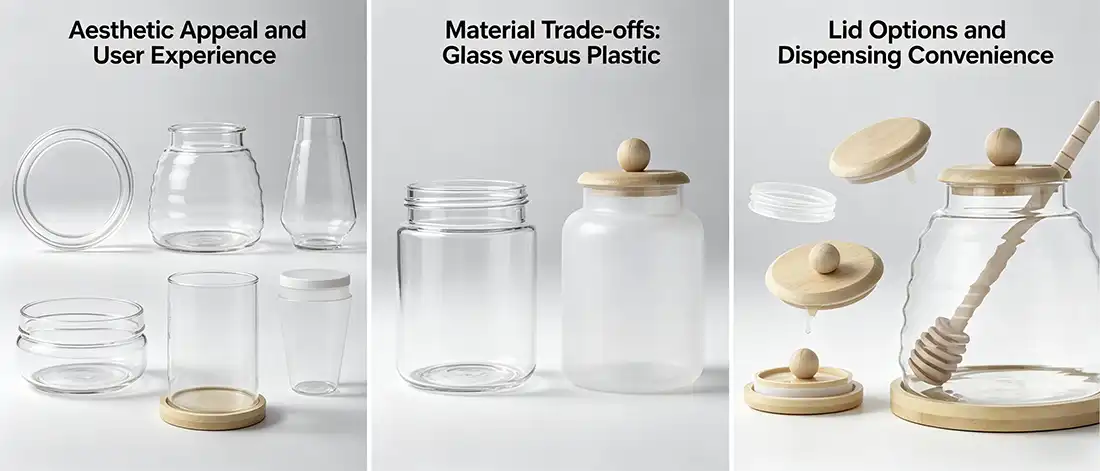
Material Trade-offs: Glass versus Plastic
In specialty stores, where visual quality is directly linked to perceived product value, glass cases command higher prices. The inert qualities of the material stop chemicals and flavors from moving around, which is important for companies that make organic honey and sell gourmet foods. Transparency lets you check the quality of the product without having to open the container. This cuts down on returns and boosts customer trust. But glass is naturally fragile, so it needs to be handled carefully and shipped in protective packaging. This makes it more expensive for foreign distributors to ship goods.
Plastic alternatives are less likely to break and weigh less, which means that big orders will save you money. Still, they give up the high-end look that is needed for business gifts and high-class hospitality displays. Because plastic lets oxygen and light through, honey breaks down faster, which shortens its shelf life and could change the unique flavors that make artisanal goods stand out. The choice of materials you make will eventually show how you want to position your brand, whether you're trying to compete on price or quality within specific market segments.
Lid Options and Dispensing Convenience
Closure methods have a big effect on how happy users are and how long products last. Screw-top metal lids with plastisol linings make hermetic seals that keep out air and wetness during long-term storage. These are great for store items that need to be tamper-evident and stay stable on the shelf for a long time. Premium products, like Muzhishi's FP-H-001 model, have wooden knob-topped closures that add a touch of luxury that makes opening gifts more enjoyable while still keeping the air out.
Food service businesses that want to control portions and make things easier to use on high-volume breakfast tables or in cooking use flip-top dispensers and squeeze caps. The choices you make should match how your target customers usually use your products. For example, store customers like resealable options so they can eat them over time, while event caterers like single-service options that make things easier and lower the risk of cross-contamination. Knowing about these useful factors helps purchasing teams choose closing systems that make things work better without making the cost of each unit go over the budget.
Sizing Guide and Customization for Round Honey Jars
Matching Capacity with Product Strategy
The size of the container has a direct effect on what people buy and how well material is managed. Standard 4-ounce honey jars work well for sampler sets and specialty variety assortments that encourage people to try before they buy, while 12-ounce jars are best for everyday use around the house. This container holds 500ml, which is about 17 ounces, and is big enough for gift presents while still being small enough to fit on a store shelf. Larger 32-ounce sizes are better for bulk buyers and food service accounts that need to restock often.
Size choice should be based on the product's density and crystallization properties. You can still get creamed honey and naturally crystallized honey in jars with wider openings that make scooping easier. On the other hand, liquid honey flows easily from jars with smaller openings that control pour rates. Limited-edition sizes are good for seasonal goods because they create a sense of urgency without leaving wholesalers with too much extra inventory. Making sure that the sizes of your jars match the sizes of your current labeling equipment and the shapes of your shipping cartons will save you a lot of money when you need to increase production.
Customization Techniques for Brand Differentiation
Surface treatments can turn plain packages into unique brand assets that stand out on the shelf. Metallic foils in gold, silver, or copper are applied by hot stamping. These foils catch the light and give off an air of luxury, making them perfect for premium honey varieties and business gifts. Frosting techniques make matte finishes that soften the look of things while also making them easy to grip. These finishes are popular with home decor brands that want to show things in an understated way. Inside engraving gives lasting branding that doesn't wear off like labels do. This is great for reusable containers in restaurants where washing them over and over would damage the graphics on the outside.
Screen printing lets you use multiple colors and photographic detail to make designs that tell complicated brand stories on small pieces of packaging. This method can handle gradient effects and fine writing that can't be done with regular labeling. However, because of the high cost of setup, it's only really cost-effective for orders that are over a few thousand units. Digital printing technologies now allow for shorter runs with the same quality, which is good for new businesses and holiday campaigns that need to be flexible. Color customization goes beyond decorating the outside of the glass and includes the glass itself. For example, amber tinting protects light-sensitive honey types from UV rays, and colored bases make gift sets look more interesting.
Bulk Ordering Considerations and MOQs
Different suppliers have very different minimum order amounts, which can be anywhere from a few hundred units for stock designs to tens of thousands of units for fully customized orders. Established makers usually set higher MOQs to cover the costs of investing in tools and changing over production. Trading companies, on the other hand, may combine smaller orders from several clients to meet factory minimums. Knowing these limits helps procurement teams find the right mix between the need for customization and the need to keep working capital and storage space at a minimum.
Lead times get longer as the customization gets more complicated. Stock honey jars with names already on them ship within days, but custom glass colors or mold changes take 6–8 weeks from deposit to delivery. Different types of orders have different payment terms and deposit structures. For example, custom tools usually need 50% of the total cost up front, while standard goods only need 30%. Smart buyers include sample review steps in their contracts to make sure that the decorating methods meet quality standards before they commit to full production runs. Building ties with suppliers who keep common materials on hand, like Muzhishi does with local glass suppliers, can cut lead times by 10 to 15 percent and lower the cost of raw materials through buying in bulk.
Trusted Brands and Supplier Insights for Round Honey Jars
Evaluating Manufacturer Capabilities
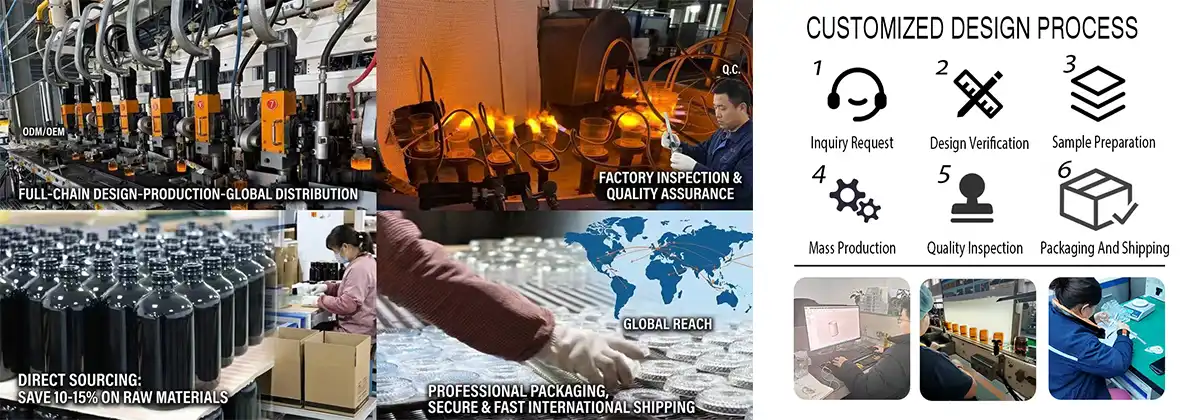
Supplier selection determines whether your packaging program becomes a competitive advantage or ongoing operational headache. Established glass manufacturers bring decades of material science expertise reflected in consistent wall thickness, annealing quality, and finish precision. Companies with ISO 9001 certification demonstrate systematic quality control, including dimensional verification using laser micrometers and thermal shock testing that predicts field performance. These capabilities matter particularly for automated filling operations where neck finish variations cause jamming and spillage that disrupt production schedules.
Comprehensive customization capabilities distinguish basic container suppliers from true packaging partners. The ability to provide multiple decoration processes—including frosting, engraving, and advanced screen printing—through integrated production capabilities helps streamline project management and reduce coordination complexity. Suppliers with in-house design teams can convert conceptual branding ideas into production-ready specifications while identifying potential manufacturing challenges before they affect project schedules. In addition, access to established glass manufacturing infrastructure, such as the industrial cluster in Xuzhou, can contribute to better cost efficiency and stronger supply chain resilience during periods of raw material fluctuation or supply shortages.
Importance of Certifications and Compliance
Documentation requirements vary dramatically across export markets, making supplier compliance capabilities essential for international operations. FDA food contact notifications and EU Regulation 1935/2004 compliance confirm containers won't contaminate contents through chemical migration. California Prop 65 certification addresses lead and cadmium content, mandatory for U.S. distribution regardless of actual sale location due to logistics pathway uncertainties. Suppliers experienced in global trade maintain current certifications and readily provide the commercial invoices, packing lists, and certificates of origin required for smooth customs clearance.
Quality documentation extends beyond compliance certificates to batch traceability systems that identify production dates, glass batch numbers, and inspection records. This capability becomes critical when addressing isolated quality issues without scrapping entire shipment inventories. Suppliers offering material safety data sheets (MSDS) and product liability insurance demonstrate professionalism that protects your business from downstream claims. The 24-hour response commitments that distinguish premium suppliers like Muzhishi reflect organizational depth and customer service prioritization that prevent small issues from escalating into major disruptions.
Building Strategic Supplier Partnerships
Transactional purchasing relationships focus narrowly on per-unit costs, missing opportunities for collaborative value creation. Strategic partnerships develop when suppliers invest time understanding your business model, market positioning, and growth trajectory. This knowledge enables proactive recommendations—suggesting design modifications that reduce breakage rates, identifying emerging decoration trends that refresh product lines, or alerting you to raw material price movements that inform purchasing timing strategies.
Long-term partnerships unlock preferential treatment during capacity constraints when suppliers must allocate limited production slots across competing customers. Established relationships also facilitate flexible payment terms and inventory consignment arrangements that improve working capital efficiency. Suppliers who maintain stock of your custom closures and decoration materials enable rapid reorder fulfillment without repeating setup processes, compressing lead times from weeks to days. The cost advantages flowing from established supplier partnerships—Muzhishi's local sourcing relationships reduce raw material expenses by 10-15%—accumulate significantly across multi-year procurement volumes, improving overall profitability beyond initial price negotiations.
Conclusion
Selecting the optimal honey jar requires balancing multiple considerations across material quality, design functionality, customization possibilities, and supplier capabilities. Round glass containers offer exceptional versatility for B2B buyers across retail, hospitality, gift, and distribution channels, combining premium aesthetics with practical preservation properties. Success demands moving beyond surface-level price comparisons to evaluate total cost of ownership, including breakage rates, operational efficiency impacts, and supplier partnership value. The procurement process becomes strategic when specifications align precisely with market segment demands while leveraging supplier expertise and production economies. By implementing systematic evaluation frameworks and building collaborative supplier relationships, businesses transform packaging from commodity expense into competitive differentiator that strengthens brand positioning and customer loyalty across diverse commercial applications.
FAQ
Why does airtightness matter for honey jar selection?
Airtight sealing prevents moisture absorption that causes fermentation and flavor deterioration in honey. Quality closures maintain seal integrity through temperature fluctuations during storage and shipping. The hermetic barriers also block oxygen exposure that accelerates crystallization and darkens honey over time, directly impacting shelf life and product quality perception.
What customization options work best for brand differentiation?
Screen printing delivers vibrant multi-color graphics suitable for retail products, while hot stamping adds metallic luxury appropriate for gift applications. Frosting creates sophisticated matte finishes popular in home décor contexts. Custom color glass and inside engraving provide permanent branding for reusable containers in hospitality settings. The optimal choice depends on your brand positioning, target channel, and order volumes.
How do glass jars compare to plastic for wholesale honey procurement?
Glass projects premium quality essential for specialty retail and corporate gifts, with superior preservation properties and complete recyclability. Plastic offers lower breakage risks and reduced shipping weights but sacrifices perceived value and allows oxygen permeability that shortens shelf life. Material selection should align with brand positioning and target market expectations within your specific business model.
Partner with Muzhishi for Premium Round Honey Jars
Xuzhou Muzhishi Crafts Co., Ltd. brings two decades of specialized expertise in food-grade glass manufacturing to your honey packaging challenges. Our 500ml cylindrical containers feature premium soda-lime glass construction with wall thickness precision within ±0.5mm tolerances, ensuring consistent quality across production runs. As an experienced round honey jars manufacturer, we offer comprehensive customization including hot stamping, frosting, inside engraving, and screen printing to create distinctive brand assets that command shelf attention. Our one-stop service encompasses design consultation, rapid sampling within 3-5 days, and complete export support including customs documentation and global logistics coordination.
Local supplier partnerships reduce raw material costs while maintaining inventory of common materials to compress lead times. ISO 9001 quality protocols ensure every jar meets rigorous thermal shock resistance and dimensional precision standards. Contact our dedicated account managers at long@muzhishi.com to discuss your specific requirements and request free samples. Visit mzsglass.com to explore our full product range and discover how strategic packaging partnerships transform operational efficiency and brand differentiation across retail, hospitality, and gift market segments.
References
1. Johnson, M. (2022). "Food Packaging Materials and Consumer Perception in Premium Markets." Journal of Food Science and Technology, 59(3), 445-458.
2. Williams, R. & Chen, L. (2023). "Glass Container Performance Standards for Viscous Food Products." Packaging Engineering Quarterly, 18(2), 112-127.
3. Anderson, K. (2021). "Sustainable Packaging Solutions in the Specialty Food Industry." International Journal of Retail & Distribution Management, 49(7), 892-908.
4. Thompson, S. (2023). "B2B Procurement Optimization Strategies for Food Service Packaging." Supply Chain Management Review, 27(4), 34-49.
5. Davies, P. & Martinez, J. (2022). "Material Science Applications in Food-Grade Glass Manufacturing." Glass Technology: European Journal of Glass Science and Technology Part A, 63(5), 156-171.
6. Roberts, E. (2021). "Brand Differentiation Through Packaging Innovation in Artisanal Food Markets." Journal of Brand Management, 28(6), 623-639.

Our customers’ satisfaction speaks for our quality — contact us to experience the same reliable service.