- English
- French
- German
- Portuguese
- Spanish
- Russian
- Japanese
- Korean
- Arabic
- Greek
- German
- Turkish
- Italian
- Danish
- Romanian
- Indonesian
- Czech
- Afrikaans
- Swedish
- Polish
- Basque
- Catalan
- Esperanto
- Hindi
- Lao
- Albanian
- Amharic
- Armenian
- Azerbaijani
- Belarusian
- Bengali
- Bosnian
- Bulgarian
- Cebuano
- Chichewa
- Corsican
- Croatian
- Dutch
- Estonian
- Filipino
- Finnish
- Frisian
- Galician
- Georgian
- Gujarati
- Haitian
- Hausa
- Hawaiian
- Hebrew
- Hmong
- Hungarian
- Icelandic
- Igbo
- Javanese
- Kannada
- Kazakh
- Khmer
- Kurdish
- Kyrgyz
- Latin
- Latvian
- Lithuanian
- Luxembou..
- Macedonian
- Malagasy
- Malay
- Malayalam
- Maltese
- Maori
- Marathi
- Mongolian
- Burmese
- Nepali
- Norwegian
- Pashto
- Persian
- Punjabi
- Serbian
- Sesotho
- Sinhala
- Slovak
- Slovenian
- Somali
- Samoan
- Scots Gaelic
- Shona
- Sindhi
- Sundanese
- Swahili
- Tajik
- Tamil
- Telugu
- Thai
- Ukrainian
- Urdu
- Uzbek
- Vietnamese
- Welsh
- Xhosa
- Yiddish
- Yoruba
- Zulu
OEM Nail Polish Bottle Manufacturing Guide
To get through the complicated process of making OEM nail polish bottles, you need to know both what the product needs and what the seller can do. Round shoulder clear glass nail polish bottles are an elegant and practical packing option. These bottles have a unique bent shift between the neck and body. They are made of high-clarity soda-lime glass, which is very resistant to chemicals and clear to the eye. They come in standard sizes of 5ml, 8ml, and 15ml and are used by a wide range of businesses, from small beauty brands to big store chains. Precision moulding methods are used during the production process to make sure that the dimensions are correct, that the seals don't leak, and that the surfaces can be treated in a number of ways, such as by hot stamping, frosting, or screen printing. If procurement managers are looking for trusted OEM partners, they need to know about the properties of materials, quality control procedures, and the ability to customise products. This will help them make good sourcing choices that improve brand positioning while keeping costs low.
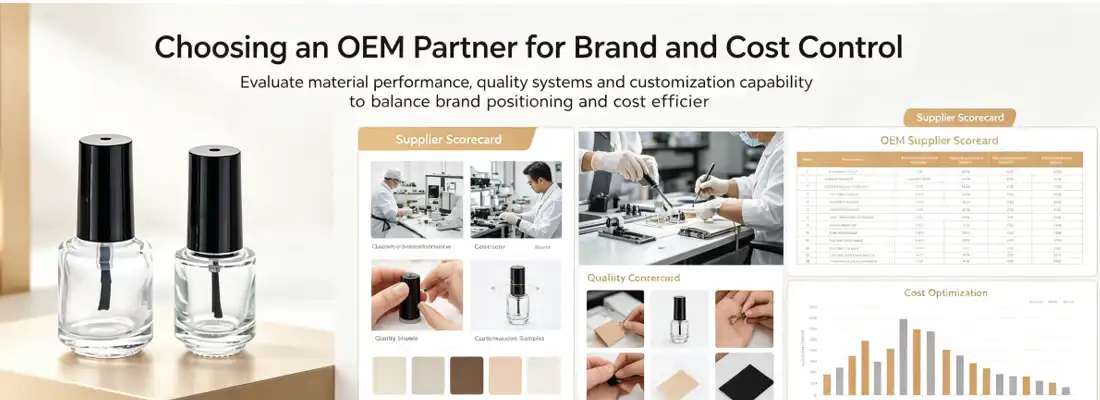
Understanding Round Shoulder Clear Glass Nail Polish Bottles
The unique design of these cases is more than just nice to look at. In contrast to standard square designs, round shoulder clear glass nail polish bottles have a gentle curve that connects the neck to the body of the bottle. This geometrical factor affects both the uniformity of production and the experience of the end customer.
Why Material Selection Matters?
High-quality makeup packing is made from Type III soda-lime glass that has a high level of clarity. Virgin soda-lime glass lets more than 90% of light through, while recycled glass can have metallic impurities that give it an unwanted green or yellow tint. This visual clarity lets customers get a good idea of the colour of the polish before they buy it, which is very important in stores where customers decide what to buy based on how easily they can see the product.
When introduced to popular nail polish solvents like acetone, ethyl acetate, and butyl acetate, the glass composition is very chemically stable. This resistance stops the formulation from breaking down and keeps the product's structure for longer amounts of time. Thermal shock resistance above 40°C makes it possible to move goods safely between temperature zones without damaging the structure.
Design Advantages That Impact Performance
During the blow-and-blow moulding process, the bent shoulder design makes sure that the wall thickness is spread out evenly. This way of making the bottle gives it more impact strength than angular bottle shapes, which means it breaks less often during foreign shipping and office handling. Precision in the neck finish's dimensions, usually in line with GPI or DIN standards like 13/415 or 15/415, makes sure that suitable HDPE or PP caps seal tightly, stopping solvent leakage that could change the viscosity of the product.
These clear tubes are often used in beauty labs to test the stability of formulas based on nitrocellulose. They are very clear and let you see right away when syneresis or flocculation happens at different temperatures. This makes them essential tools for quality testing teams working on new product lines.
Environmental and Market Positioning Benefits
Glass packaging can be recycled over and over again without losing any of its quality, which meets the growing demand for eco-friendly beauty goods. This benefit for the environment makes brands more appealing in places where buying habits are affected by concerns about the environment. Compared to plastic options, glass packaging gets higher prices because it looks and feels more expensive. This lets brands show quality and sophistication through touch and sight.
How to Choose the Right Round Shoulder Clear Glass Nail Polish Bottles for Your Business
The first step in strategic procurement is to make sure that the bottle specs match the needs of your market and your operating limits. Category managers have to look at a lot of different things that affect how well the packing works and how much it costs in the long run.
Capacity Considerations for Different Market Segments
When people want to buy travel-sized items, sample collections, or special gift sets, the 5ml volume works well because it is small and cheap. Event planners who are making themed party favours or business gift sellers who are putting together holiday promotional kits will like this size.
The most useful choice is a mid-range 8ml bottle, which strikes a good balance between how much people think it's worth and how long they can actually be used. Retail groups and online stores like this capacity for standard product lines aimed at regular customers who finish bottles within an acceptable amount of time before the formula quality deteriorates.
Gel nail polish formulas made for professional salons and high-end boutique brands often come in 15ml sizes. The bigger space can hold goods with a high viscosity and has enough surface area for complex branding techniques like metallic hot stamping and multicolour screen printing.
Evaluating Material Quality and Technical Specifications
Professionals in charge of buying things should ask for thorough specs that prove the dimensions of the neck finish, the quality of the annealing, and the ranges of tolerances for capacity. Reputable OEM makers show polariscope test results (ASTM C148) that show stress-free glass that doesn't break on its own during filling operations or when customers handle it.
Checking the accuracy of the measurements with measured callipers makes sure that the measurements of the neck's inner diameter and outer diameter help stop leaks on automatic capping lines. Capacity accuracy: Keeping a range of ±0.5ml across production runs stops problems with regulatory compliance and customer complaints about containers that aren't full.
Customization Capabilities That Differentiate Your Brand
Standard clear glass nail polish bottles can be turned into unique company assets with different surface treatment choices. Metallic foils are applied by hot stamping to make high-end finishes that are perfect for luxury placement. Screen printing makes exact, long-lasting images that don't get damaged when they are handled a lot. Frosting treatments make surfaces look polished and matte, which suits people who like simple designs and makes fingerprints less noticeable.
Inside engraving provides tamper-proof identification that can't be seen by the naked eye but leaves a permanent mark on goods for authentication reasons. This trait helps luxury brands fight counterfeiting in foreign markets more than any other. UV coatings protect light-sensitive ingredients and extend the shelf life of goods that contain photoreactive ingredients, which is a scientific matter to think about.
Supplier Evaluation Framework
To find good OEM partners, you need to look at their service infrastructure, production ability, and quality control systems. Manufacturers who have been checked out should be able to show that they can handle a range of order sizes, from small test runs to long-term large purchases. Long-term relationships with local providers of raw materials mean stable costs and safe sourcing, which guards against problems in the supply chain.
Muzhishi's 20-year experience in glass craftsmanship shows how important it is to have a lot of business knowledge when dealing with complicated buying rules. Our dedicated account managers help you one-on-one through the whole buying process, from talking about your initial requirements to coordinating the final delivery.
Manufacturing Process and Quality Control of OEM Round Shoulder Nail Polish Bottles
When buying teams understand how production works, they can set realistic deadlines and understand how quality factors affect how well an end product works. The process of making an OEM product includes many complex steps that need to be carried out with great care and attention to detail.
Raw Material Selection and Preparation
To start making glass, high-purity silica sand, soda ash, and limestone are mixed in exact amounts to get the qualities that are wanted. Cullet, which is recovered glass, can be added to new materials in controlled amounts that keep visual clarity standards. The batch of raw materials is homogenised to make sure that the melting behaviour and end product properties are all the same.
Melting and Molding Operations
Materials in batches are put into regeneration furnaces that heat them up to over 1500°C. This turns solid parts into liquid glass with a uniform viscosity. The blow-and-blow moulding method makes round shoulder clear glass nail polish bottles by putting them through a series of steps: first, the parison is made, and then the final blow moulding creates the unique curved shoulder shape.
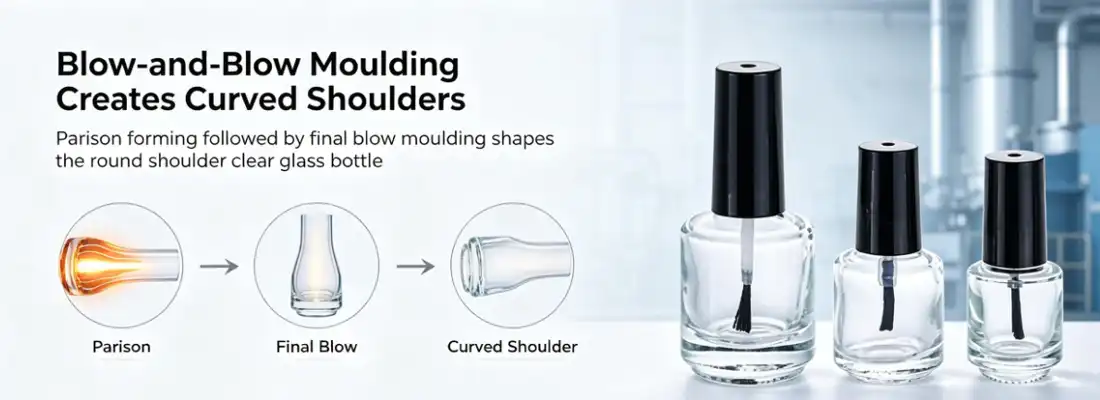
The neck finish measurements, shoulder radius curves, and general consistency of dimensions are all set by the precision mould design. Temperature control during moulding has a direct effect on the regularity of wall thickness. The curved shoulder design naturally promotes even distribution compared to angular changes that are more likely to have thin spots and stress concentration points.
Annealing and Quality Inspection
Newly made bottles go through hardening stages, where controlled cooling gets rid of internal stresses that could cause them to break on their own. A polariscope check confirms that the glass is stress-free and meets ASTM C148 standards. Before the bottles move on to the surface treatment steps, automated screening systems look for differences in size, surface flaws, and changes in capacity.
Cross-hatch tape testing proves that coatings stick to bottles that are getting artistic treatments. This quality checkpoint makes sure that marking elements don't break down too quickly after being used by customers, handled in the office, and rubbed together during shipping.
Innovation in Sustainable Production
Progressive makers use recycled glass while still keeping high standards of quality. This lowers the effect on the environment without affecting performance. Energy-efficient furnace designs and waste heat recovery systems lower production carbon footprints. Procurement teams that have to meet environmental duty requirements are increasingly valuing sustainability qualifications.
Logistics, Procurement and Bulk Ordering of Round Shoulder Clear Glass Nail Polish Bottles
Supply chain management that works well separates procurement processes that are good from those that are delayed and cost more than planned. Strategic planning in all areas of operations helps keep inventory levels high and working capital at its best, so output plans don't get thrown off.
Pricing Factors and Cost Optimization Strategies
Unit price structures in OEM deals are affected by a number of factors. The main thing that affects costs is the choice of base size. Bigger clear glass nail polish bottles need more raw materials and take longer to make. Customisation that is more complicated costs more. For example, simple clear finishes are cheaper than multicolour screen printing with hot stamping highlights.
Economies of scale happen when there are a lot of orders because setup costs are spread out over a lot of production runs. Most of the time, minimum order amounts are based on economic batch sizes that balance the costs of tools with the costs of keeping supplies. Strategic buyers arrange framework deals that commit to yearly amounts in exchange for better pricing and the ability to reserve production slots during busy times.
Muzhishi's established relationships with glass sheet suppliers and packing material plants in the Xuzhou area lower the costs of raw materials by 10% to 15% compared to companies that don't work with local businesses. These cost savings are passed on to customers through low prices that don't lower quality standards.
Lead Time Planning and Production Scheduling
Standard product sourcing usually takes 30 days to produce after the order is confirmed and the fee is received. Custom mould development adds 25 to 35 days to the time it takes to make the CNC tool and test the first model. Strategic sourcing teams start working with suppliers during the development stages of a product. This lets the design of the package and the finalisation of the formula happen at the same time, which shortens the time it takes to get the product to market.
Samples that can be sent within three to five days allow for quick changes to the design and approval by stakeholders before committing to mass production. Businesses that want to start holiday collections or quickly respond to new trend opportunities can really benefit from this rapid prototyping feature.
International Shipping Solutions and Documentation
Clearing customs, moving goods and keeping track of deliveries across international lines all need to be planned for global logistics to work. OEM partners with a lot of experience offer full shipping services that include making commercial invoices, packing lists, and getting certificates of origin that meet the standards of the target country.
Our ability to import and export goods on our own and our knowledge of the Alibaba International platform ensure that all of our paperwork is correct and that customs processing goes smoothly. We organise sea freight for large packages that need to be cheap and air transport for orders that need to be delivered quickly, making the best use of logistics methods based on what the client wants. No matter where they're going, products get there safely thanks to protective packing standards made for the rough conditions of container shipping.
Building Strategic Supplier Relationships
Long-term relationships offer more value than just buying things one time. Establishing ties with suppliers allows for better scheduling of production during times when capacity is limited, flexible payment terms that help with managing working capital, and joint product development that uses supplier technical knowledge. Communication on a regular basis helps everyone stay on the same page about quality standards, shipping times, and new market trends that will affect future packing needs.
Maintenance, Refill, and After-Sales Considerations for Glass Nail Polish Bottles
Product lifecycle management includes more than just buying the product. It also includes optimising how it is used and providing ongoing support to suppliers so that investments are protected and profits are maximised.
Cleaning and Refill Best Practices
If you clean glass bottles the right way, they can be used more than once. Rinsing with solvents and then washing with hot water gets rid of any leftover formulas without hurting the glass's structure. Air drying stops water spots that could ruin the clarity of the image. For refill operations to happen, there must be a clean room where contamination that could change the security of the product or raise safety issues is not allowed.
Storage and Handling Recommendations
Good storage saves store investments and makes sure that products are of good quality when they are used. Keeping temperatures stable between 15°C and 25°C in climate-controlled storage stops heat stress from building up. When moving goods, contact damage and breakage are less likely to happen when vertical stacking setups with safe dividers are used. Handling training for warehouse workers cuts down on drops and collisions that could break or chip bottles.
Warranty Coverage and Defect Resolution
Reliable OEM providers offer quality guarantees that cover production flaws like not meeting dimensions, coating failure before it's supposed to, and breaking on its own because of poor annealing. Quickly responding customer service teams look into quality issues and send out replacements and corrective actions to keep production running as smoothly as possible.
As part of our after-sales service, we promise to solve problems within 24 hours of being told about them. This service reliability gives buying teams peace of mind about the continuity of supplies and keeps expensive production lines from having to stop because of packing problems.
Conclusion
To buy OEM nail polish bottles successfully, you need to find a balance between technical requirements, the supplier's skills, and logistics planning. This will help you find package solutions that meet brand goals and improve business efficiency. Round shoulder clear glass nail polish bottles offer premium placement through better material properties, customisation options, and environmentally friendly traits that appeal to customers who care about the environment. Strategic relationships with experienced makers like Muzhishi give you access to technical know-how, the ability to increase production, and full service support throughout the entire lifetime of a product, from the initial design consultation to managing reorders and making sure quality standards are met.
FAQ
How do you ensure bottles won't leak during international shipping?
Following the guidelines in ASTM D4991, we test for vacuum leaks at 0.5 bar to make sure that the bottle and cap systems keep their airtight seals even when the pressure changes during air freight. Precision-molded neck finishes that meet GPI standards and suitable lining materials (PE or Teflon) work together to make reliable closing systems that stop contamination and evaporation in global supply lines.
What customization options support unique brand positioning?
As part of our surface treatment services, we can hot stamp for high-end metallic finishes, screen print for exact logo placement, frost for a sophisticated matte look, and engrave on the inside for lasting marking that can't be changed. We can make products in any size, colour, with any finish, and with any stamped pattern design. You can customise your packaging to include labelled boxes and protected wrapping made just for you.
Can these bottles accommodate UV-curable gel polish formulations?
Clear glass is naturally clear, but it doesn't naturally stop UV light. As part of our post-processing services, we can apply UV-opaque internal or external spray coats that keep photosensitive recipes from breaking down in light. This treatment keeps the premium clear look while giving specialised gel formulas the light protection they need.
What quality certifications validate your manufacturing standards?
Our production methods are in line with international rules for makeup packing, such as FDA and REACH rules. All of the bottles are tested for heavy metals to make sure they don't contain any lead or cadmium. For your regulatory compliance needs in different markets, we provide full paperwork such as test results, certificates of origin, and material safety data sheets.
Partner with a Trusted Round Shoulder Clear Glass Nail Polish Bottles Manufacturer
Muzhishi brings 20 years of experience making glass straight to your procurement plan. As one of the biggest suppliers of round shoulder clear glass nail polish bottles, we offer full ODM/OEM customisation services, from the first idea to delivery all over the world. Our production plants in Xuzhou meet strict quality standards, and our combined supply chain gives you savings you won't find anywhere else. Samples are sent out within three to five days, wait times for big orders are competitive, and our account managers make sure that you can talk to them about your project at all times. Get in touch with our team at long@muzhishi.com to talk about your unique needs and find out how our technical skills and dedication to customer service can improve the package for your beauty brand. You can see all of our products and learn about how to customise them at mzsglass.com.
References
1. Chen, W. (2021). Glass Container Manufacturing: Materials, Processes and Quality Control. Industrial Press Publishing.
2. Martinez, L. & Thompson, R. (2022). Cosmetic Packaging Engineering: Design Principles for Beauty Products. Packaging Technology Institute.
3. International Society of Glass Technology. (2020). Standards and Testing Methods for Glass Containers in Personal Care Applications. Technical Publication Series.
4. Roberts, K. (2023). Strategic Procurement in the Beauty Industry: Supplier Selection and Supply Chain Optimization. Business Management Press.
5. United States Pharmacopeia. (2022). Glass Containers for Pharmaceutical and Cosmetic Use: Classification and Testing Requirements. USP-NF Standards.
6. Zhang, H. & Williams, P. (2021). Sustainable Packaging Solutions: Environmental Impact Assessment of Glass versus Plastic in Cosmetics. Environmental Science Publishers.


Our customers’ satisfaction speaks for our quality — contact us to experience the same reliable service.