- English
- French
- German
- Portuguese
- Spanish
- Russian
- Japanese
- Korean
- Arabic
- Greek
- German
- Turkish
- Italian
- Danish
- Romanian
- Indonesian
- Czech
- Afrikaans
- Swedish
- Polish
- Basque
- Catalan
- Esperanto
- Hindi
- Lao
- Albanian
- Amharic
- Armenian
- Azerbaijani
- Belarusian
- Bengali
- Bosnian
- Bulgarian
- Cebuano
- Chichewa
- Corsican
- Croatian
- Dutch
- Estonian
- Filipino
- Finnish
- Frisian
- Galician
- Georgian
- Gujarati
- Haitian
- Hausa
- Hawaiian
- Hebrew
- Hmong
- Hungarian
- Icelandic
- Igbo
- Javanese
- Kannada
- Kazakh
- Khmer
- Kurdish
- Kyrgyz
- Latin
- Latvian
- Lithuanian
- Luxembou..
- Macedonian
- Malagasy
- Malay
- Malayalam
- Maltese
- Maori
- Marathi
- Mongolian
- Burmese
- Nepali
- Norwegian
- Pashto
- Persian
- Punjabi
- Serbian
- Sesotho
- Sinhala
- Slovak
- Slovenian
- Somali
- Samoan
- Scots Gaelic
- Shona
- Sindhi
- Sundanese
- Swahili
- Tajik
- Tamil
- Telugu
- Thai
- Ukrainian
- Urdu
- Uzbek
- Vietnamese
- Welsh
- Xhosa
- Yiddish
- Yoruba
- Zulu
The Sweet Science of Packaging: A Comprehensive Guide to Honey Jars
Choosing the right honey packaging is more than just picking a container. It's a smart business decision that affects how well the product stays fresh, how people see your brand, and, in the end, your bottom line. Round honey jars in the round shape have become the industry standard because they look great and work well. These cylinder-shaped glass containers keep honey's natural qualities while showing off its golden clarity, making a visual connection with customers who care about quality right away. If you know how to choose the right honey jars, you can turn buying packaging into a competitive edge that boosts product value and customer experience, whether you're sourcing for retail chains, creating corporate gift lines, or adding to your hospitality offerings.

Understanding Round Honey Jars: Features and Benefits
The Evolution of Cylindrical Glass Packaging
Since the early 1900s, honey packaging has mostly been cylindrical, and this hasn't happened by chance. Because of its shape, the geometry has structure benefits that square or hexagonal shapes can't match. The continuous curve spreads the internal pressure out evenly, which cuts down on stress spots that usually lead to breaks during transport. This circular cross-section also helps the flow of product more smoothly during high-speed automatic filling operations. This keeps air from getting trapped, which can weaken the seal.
In the last few decades, manufacturing accuracy has changed a lot. With today's production methods, wall thickness uniformity is achieved within ±0.5mm tolerances. This is an important requirement that stops thermal shock fails during pasteurization processes. When honey makers heat-treat their products to keep them from crystallizing, the consistent dimensions make sure that the honey will expand in a predictable way, which protects both the product and the investment in the packaging.
Material Science: Why Glass Remains the Gold Standard?
Compared to plastic options, food-grade glass packaging is completely chemically inert. Because honey is naturally acidic (pH ranges from 3.2 to 4.5), it can be hard to store. Glass containers stay completely stable, so packaging parts don't move into the product. This is a worry that has led regulators to closely look at some plastic formulations.
The makeup of the material is very important. Premium honey jars are made of high-quality soda-lime glass that has very little iron in it, which makes it very clear. This openness helps both buyers and sellers. It lets buyers see how good a product is before they buy it, and it gives sellers more reasons to put it at the top of the price range. The non-porous surface stops flavors from absorbing, so used jars don't hold on to old tastes. This is an important thing to think about for environmentally conscious people who refill containers.
Capacity Options and Market Positioning
The 500ml volume is the best compromise between how much people think it's worth and how much they drink in retail settings. According to research, this size fits with how often things are used in the average home, which means that people will likely buy it again before it goes bad. Larger sizes work best for food service and bulk sale, while smaller sizes are best for specialty honeys that should be priced higher per unit because of where they come from or the unique qualities of each variety.
How a product is viewed is directly related to the size of its packaging. The same honey in a 250ml jar is seen as a gourmet treat, while the same honey in a 1000ml jar is seen as an everyday store item. Producers can divide markets successfully using packaging as the main differentiator, without changing the actual product, thanks to this psychological pricing mechanism.
Preservation Technology and Shelf Life Extension
There is more to the link between packaging and product life than just keeping the product inside. Due to its low water activity, honey automatically stops microbes from growing, but the way it is packaged has a big impact on how long it stays in good texture and appearance. When you use round glass jars with lids that are properly sealed, you create an airtight environment that stops moisture from absorbing, which is what normally causes honey products to sour.
Cylindrical jars have smooth walls on the inside, which reduces the number of places where crystals can start. Angled containers with corners have a lot of tiny surface irregularities that help crystals form faster. Crystallization doesn't necessarily mean that something is bad, but customers often think of it as a sign of lower quality, which makes this packing benefit important for business. Producers say that premium glass containers with improved closure methods keep their freshness for 6 to 12 months longer.
How to Choose the Right Round Honey Jar for Your Business?
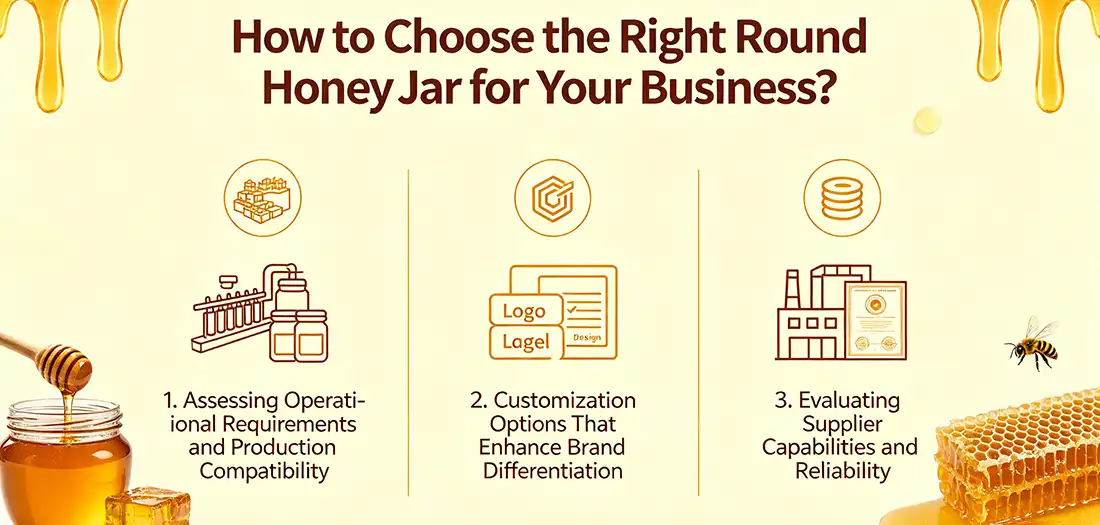
Assessing Operational Requirements and Production Compatibility
Assessment of the production line should come before any choices about purchases. Filling machines that are made for specific jar sizes can't handle big differences without expensive conversion processes. The neck finish specs (the threaded part that accepts closures) must exactly match the capping machinery that is already in use. Even small changes in the thread pitch or thickness can lead to sealing problems that waste product and cause production to stop.
Labeling tools also limits the choice of containers. Rotary labeling systems work well with cylindrical jars, but differences in width make it harder to place labels correctly. Before agreeing to bulk orders, production managers should make sure that the sizes of the honey jars they want to buy are within the range of adjustments that their equipment can make. Testing samples with real production tools keeps surprises from happening that cost a lot of money after the inventory comes in.
To plan for throughput capacity, you have to figure out the total cycle time per unit, which includes processes like filling, capping, labeling, and packaging. Line speed is affected by the weight of the jars; slower conveyor speeds are needed for heavy containers to keep them from falling over and breaking. This seemingly small detail adds up over millions of units every year, which could mean that more production shifts are needed to meet volume promises.
Customization Options That Enhance Brand Differentiation
Using surface treatment technologies, ordinary containers can be turned into unique brand products. Frosting gives a surface a beautiful matte finish that spreads light beautifully and adds texture. This method works especially well for high-end honey goods whose packaging shows that they are made by hand. The frosted surface can also hold printed images without giving the impression of a "floating label" like sticky labels do. This makes an integrated design that doesn't peel or get damaged by water.
With hot stamping, metallic foil is applied directly to glass surfaces, making details that look expensive that you can't get with paper labels. Gold or silver stamping greatly increases the value that people think something is worth, which supports premium store positioning. Because directly applied decoration is permanent, you don't have to worry about labels coming off in high-humidity or cold storage areas.
Inside engraving is the most personalized option because it creates three-dimensional brand features inside the glass wall. This advanced method creates packaging that acts as a permanent brand ambassador, encouraging people to reuse containers, which increases brand exposure for a long time after the initial buy. The investment works well for high-volume uses where the cost of the tools is spread out over many production runs.
Evaluating Supplier Capabilities and Reliability
Supplier selection is more than just looking at unit prices; it also looks at the total cost of ownership. Reliability of lead times affects the cost of keeping supplies and the ability to adapt to changes in demand. If a supplier offers samples within three to five days, it means they have a well-established logistics system and good customer service. These are signs of operational maturity that can be used to predict on-time delivery performance.
Minimum order quantities (MOQ) have a big effect on how much working cash you need. Smaller buyers gain when suppliers offer lower MOQs, even if the cost per unit is a little higher. This is because they don't have to invest as much in inventory, which helps their cash flow. Storage costs, the risk of products going out of style, and the opportunity cost of capital that is stuck in inventory should all be taken into account in the estimate.
Geographic sourcing decisions involve balancing cost against logistics complexity. Asian producers can usually offer better prices because they can easily get raw materials and make a lot of them. However, shipping takes longer and going through customs procedures makes things more complicated. When handling time-sensitive product launches or seasonal demand spikes, domestic suppliers are helpful because they can get things done faster and make communication easier. Strategic buyers often use a mix of domestic and international sellers, keeping domestic suppliers for short-term needs and using international partners for steady base volume.
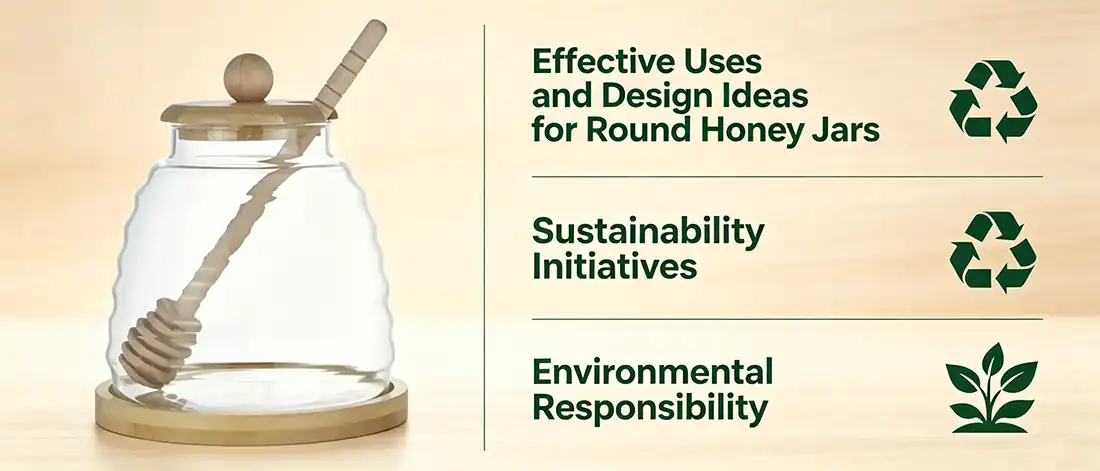
Effective Uses and Design Ideas for Round Honey Jars
Innovative Labeling and Brand Storytelling Techniques
With today's printing technologies, packaging can tell rich brand stories that set goods apart in crowded markets. Screen printing uses ceramic inks that forever bond with glass during high-temperature curing. This makes a design that won't fade even after being washed many times. This durability is important for containers that can be used again and again after the first use, giving the brand more exposure over years of home use.
Adding a QR code to a static piece of packaging turns it into a dynamic marketing tool. Codes on labels or on the glass itself take customers to origin stories, production movies, recipe ideas, and information about sustainability. This digital extension opens up ways to interact with brands that weren't possible with traditional packages. This builds relationships between brands that make people loyal and likely to buy from them again. Analytics from code reading give useful information about how people use products, which helps with the development of new products.
Premium honey brands like transparent labeling, which uses minimal covering to let the product show through. This way of thinking about design shows that you trust the quality of the product while also making it look good enough to stand out from fully labeled competitors. Because customers can see any differences right away, this method requires very consistent products and close attention to filling levels.
Cross-Category Applications Beyond Honey Products
Because of their flexible shape, cylindrical glass cases can be used for a lot more than just storing honey. Artisanal food makers use them to package jams, nut butters, and unique condiments because glass packaging makes the food look more expensive. The 500ml size is good for serving yogurt in portions, and the airtight seal keeps dry goods like nuts, granola, and specialty coffee beans from going bad and getting wet.
More and more cosmetic companies are putting natural beauty products in food-grade glass cases, taking advantage of the fact that people associate glass packaging with cleanliness. The high-end presentation glass keeps wetness out, which is good for body scrubs, bath salts, and whipped body butters. This use across categories shows how flexible the format is and suggests that packaging companies could acquire clients other than traditional honey makers.
Home makers are a new group of people who buy high-quality containers for their own jams, oils that have been infused, and ingredients for craft cocktails. This direct to consumer route likes smaller minimum orders and sampling programs that let people try out products before they buy a lot of them. Suppliers that work with this group get high margins that make up for lower order volumes. They also get useful feedback on packaging choices that helps them make better B2B products.
Sustainability Initiatives and Environmental Responsibility
Sustainability commitments made by businesses are having a bigger impact on choices about what packaging to buy. Making glass containers from recycled cullet (crushed recycled glass) cuts down on the use of raw resources and energy for production. Forward-thinking providers keep records of the percentages of recycled content, which helps buyers meet their environmental reporting and corporate social responsibility goals.
Lightweighting programs lower the weight of glass without affecting the structure's strength. This lowers the amount of pollution released during shipping each unit. Modern engineering methods improve the spread of wall thickness by removing material from areas with low stress while keeping strength in areas with high stress. These changes have real environmental benefits that are felt along supply lines that move millions of units every year.
Take-back programs keep containers in use by creating circular flows of materials. Some suppliers give credit programs for honey jars that are returned and then inspected, cleaned, and put back into stock. This plan works best for local honey producers who have direct relationships with retailers and can still afford to use reverse logistics. This method shows care for the environment, which appeals to customers who care about sustainability and could also lower the cost of packing.
Procurement and Transaction Guidance for Bulk Round Honey Jars
Sourcing Strategies and Supplier Vetting
Procurement professionals should utilize multiple sourcing channels to ensure competitive pricing and supply security. B2B platforms specializing in packaging products provide access to numerous suppliers with verified credentials, facilitating comparison shopping across specifications and service terms. Requesting samples from 3-5 potential suppliers enables direct quality assessment before financial commitment.
Due diligence should verify manufacturing certifications relevant to food packaging, including ISO 9001 quality management systems and food safety certifications. Suppliers should readily provide documentation demonstrating compliance with regional regulations governing food contact materials. Reluctance to share compliance documentation represents a significant red flag warranting supplier elimination.
Reference checking with existing clients provides insights into delivery reliability, quality consistency, and responsiveness to issues. Long-term customer relationships indicate supplier stability and customer satisfaction—positive indicators for procurement decision-making. Newer suppliers may offer aggressive pricing to build market share but carry higher risk of service inconsistencies.
Negotiation Tactics and Cost Optimization
Volume commitments unlock pricing tiers that significantly impact total procurement costs. Buyers should calculate annual requirements accurately, potentially consolidating purchases to reach advantageous quantity breaks. However, this must balance against inventory carrying costs and obsolescence risk if design changes or demand fluctuations occur.
Payment terms represent a negotiable element often overlooked during price discussions. Extended payment terms (60-90 days) improve cash flow management, while early payment discounts (typically 2-3% for payment within 10 days) can reduce effective costs. The optimal choice depends on organizational cash position and alternative uses for capital.
Freight terms dramatically affect total landed cost. FOB (Free on Board) pricing places shipping responsibility and cost on the buyer, while DDP (Delivered Duty Paid) includes all transportation and customs costs in the quoted price. International buyers should request detailed freight quotes separately to understand this cost component and evaluate alternative shipping methods. Consolidated shipping for multiple product categories can reduce per-unit freight substantially.
Customization Workflows and Production Timelines
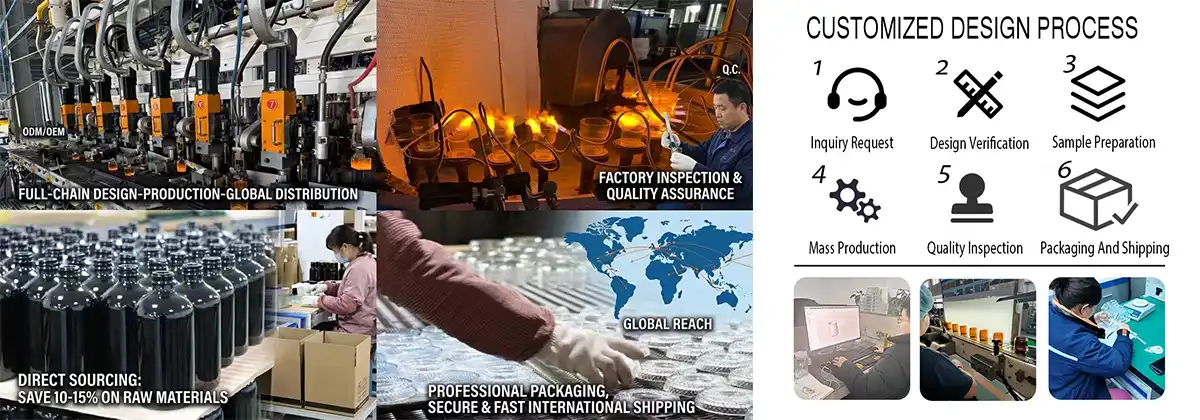
Custom decoration requires additional lead time for design approval, printing plate production, and setup validation. Buyers should allocate 2-3 weeks for this process before production begins. Providing high-resolution artwork (typically 300 DPI minimum) in specified file formats (often AI or PDF) prevents delays caused by file conversion issues.
Sample approval represents a critical milestone preventing costly misunderstandings. Suppliers should provide physical samples showing actual decoration quality, colors, and placement before proceeding to full production. This step identifies any discrepancies between buyer expectations and manufacturer interpretation while corrections remain simple and inexpensive.
Production runs for customized containers typically require 3-4 weeks after design approval, followed by shipping time based on transportation method. Air freight reduces transit to days but costs significantly more than ocean shipping, which typically requires 3-6 weeks depending on origin and destination ports. Strategic buyers plan seasonal inventory needs months in advance, utilizing economical ocean freight to minimize costs.
Logistics Coordination and Inventory Management
Container loading optimization reduces freight costs per unit. Standard 20-foot containers accommodate approximately 15,000-18,000 units of 500ml round honey jars depending on packing configuration, while 40-foot containers roughly double this capacity. Buyers should coordinate with suppliers on pallet dimensions and stacking patterns to maximize container utilization, as even small improvements compound into significant savings across multiple shipments.
Customs clearance procedures require accurate documentation including commercial invoices, packing lists, and certificates of origin. Experienced suppliers provide complete documentation packages that expedite customs processing and minimize delay risk. Buyers should verify that suppliers understand destination country requirements, as documentation errors cause expensive delays and storage charges.
Warehouse receiving procedures should include immediate inspection protocols to identify damage or discrepancies while supplier liability remains clear. Checking random samples for dimensional accuracy, decoration quality, and closure fit prevents discovering problems after inventory dispersion when remedy becomes complicated. Photographic documentation of any issues supports warranty claims or return negotiations.
Conclusion
Selecting honey packaging transcends simple container procurement—it represents a strategic business decision affecting product preservation, brand positioning, and operational efficiency. Cylindrical glass jars deliver proven performance through superior structural integrity, complete product recovery, and consumer appeal that justifies premium positioning. The transparent material showcases product quality while providing environmental sustainability that aligns with contemporary corporate responsibility expectations. Successful sourcing balances quality specifications against total cost of ownership, incorporating customization options that transform packaging into brand differentiation tools. Procurement professionals who approach packaging selection systematically—evaluating operational compatibility, supplier capabilities, and lifecycle costs—position their organizations for marketplace success while optimizing resource allocation across complex supply chains.
FAQ
What is the typical shelf life of honey stored in round glass jars?
Properly sealed honey in quality glass containers maintains optimal characteristics for 24-36 months under normal storage conditions. The key factors are moisture exclusion through effective sealing and protection from temperature extremes. Glass provides superior barrier properties compared to plastic, preventing gradual oxidation that degrades aromatic compounds. While honey technically never spoils due to its antimicrobial properties, glass packaging best preserves the sensory qualities consumers expect.
Are round honey jars compatible with automated filling equipment?
Cylindrical containers integrate seamlessly with high-speed rotary filling systems achieving 200+ units per minute. The geometric symmetry enables reliable positioning and reduces jamming incidents compared to non-circular shapes. Buyers should verify neck finish specifications match their capping machinery, as even minor dimensional variations cause sealing failures. Most suppliers provide detailed technical drawings showing critical dimensions that production managers can cross-reference against equipment specifications.
How do I ensure airtight sealing with round glass honey jars?
Seal integrity depends on matching the appropriate closure system to your product characteristics. Plastisol-lined metal lids create superior seals for long-term storage, while plastic caps with PE liners suit products with shorter distribution cycles. The jar's finish (threaded opening) must be manufactured to precise tolerances—quality suppliers maintain ±0.5mm dimensional accuracy that enables consistent sealing. Testing should include inverted storage to verify no leakage occurs under worst-case handling scenarios.
Partner with Muzhishi for Your Honey Jar Requirements
Xuzhou Muzhishi Crafts Co., Ltd. brings two decades of specialized experience in glass packaging manufacturing and export services tailored to international procurement needs. Our 500ml round honey jar collection combines premium food-grade glass construction with extensive customization capabilities including hot stamping, frosting, inside engraving, and screen printing that transform standard containers into distinctive brand assets. We provide complimentary samples with 3-5 day delivery, allowing quality assessment before commitment. Our integrated export services handle customs documentation, freight coordination, and compliance verification, simplifying international procurement workflows. Dedicated account managers deliver personalized consultation on material selection, decoration options, and supply chain optimization. Contact us at long@muzhishi.com to discuss your honey jar requirements and discover how our round honey jars manufacturer capabilities can enhance your product presentation while optimizing procurement efficiency. Visit mzsglass.com for complete specification details and customization options.
References
1. Thompson, J.M. (2021). Glass Packaging for Food Products: Materials Science and Quality Control Standards. Food Technology Press.
2. Anderson, K.L. & Roberts, D.F. (2020). Sustainable Packaging Solutions in the Global Food Industry. International Journal of Food Distribution, 45(3), 178-195.
3. Chen, W. (2022). Modern Glass Manufacturing: Quality Assurance and Production Optimization. Industrial Materials Quarterly, 38(2), 112-128.
4. Martinez, S.E. (2019). Honey Storage and Preservation: The Impact of Packaging Materials on Product Longevity. Journal of Food Science and Technology, 56(4), 1823-1836.
5. Peterson, R.A. & Williams, H.K. (2023). B2B Procurement Strategies for Food Packaging: Cost Optimization and Supplier Management. Supply Chain Management Review, 27(1), 42-58.
6. Zhang, L. & Kumar, P. (2021). Consumer Perceptions of Food Packaging: The Role of Material Choice in Brand Positioning. Marketing Science Institute Working Paper Series, Report 21-104.


Our customers’ satisfaction speaks for our quality — contact us to experience the same reliable service.