- English
- French
- German
- Portuguese
- Spanish
- Russian
- Japanese
- Korean
- Arabic
- Greek
- German
- Turkish
- Italian
- Danish
- Romanian
- Indonesian
- Czech
- Afrikaans
- Swedish
- Polish
- Basque
- Catalan
- Esperanto
- Hindi
- Lao
- Albanian
- Amharic
- Armenian
- Azerbaijani
- Belarusian
- Bengali
- Bosnian
- Bulgarian
- Cebuano
- Chichewa
- Corsican
- Croatian
- Dutch
- Estonian
- Filipino
- Finnish
- Frisian
- Galician
- Georgian
- Gujarati
- Haitian
- Hausa
- Hawaiian
- Hebrew
- Hmong
- Hungarian
- Icelandic
- Igbo
- Javanese
- Kannada
- Kazakh
- Khmer
- Kurdish
- Kyrgyz
- Latin
- Latvian
- Lithuanian
- Luxembou..
- Macedonian
- Malagasy
- Malay
- Malayalam
- Maltese
- Maori
- Marathi
- Mongolian
- Burmese
- Nepali
- Norwegian
- Pashto
- Persian
- Punjabi
- Serbian
- Sesotho
- Sinhala
- Slovak
- Slovenian
- Somali
- Samoan
- Scots Gaelic
- Shona
- Sindhi
- Sundanese
- Swahili
- Tajik
- Tamil
- Telugu
- Thai
- Ukrainian
- Urdu
- Uzbek
- Vietnamese
- Welsh
- Xhosa
- Yiddish
- Yoruba
- Zulu
Sustainable Packaging Solutions for Essential Oils
In today's B2B world, sustainable packaging options for essential oils are a smart way to be good to the earth and make money at the same time. The small essential oil bottle has become the standard for environmentally friendly packaging, especially glass versions with sizes between 5ml and 30ml that reduce material waste while protecting the product well. By being able to be used again and again, these small containers support the circular economy and leave smaller carbon footprints during shipping. They also protect the integrity of plant extracts thanks to UV-resistant materials. Companies that use eco-friendly packing meet the needs of consumers who want to know what's going on while also following the rules in different countries. This makes smart container choice a competitive advantage rather than just a business necessity.

Understanding Small Essential Oil Bottles and Their Role in Sustainable Packaging
As the wellness and aromatherapy industries have grown, they have put more stress than ever before on packing that protects both product quality and the health of the world. Glass containers made for botanical extracts now serve two purposes: they protect volatile chemicals from oxidation and reduce their effect on the environment by lasting a long time and being easy to recycle.
Typical Sizes and Material Characteristics
Most commercial uses containers with capacities between 5ml and 30ml. The 12ml size is the best compromise for both retail and wholesale sales. When it comes to materials, borosilicate glass is the best because it can handle high temperatures and doesn't mix with chemicals, which could ruin the cleanliness of the oil. Amber glass naturally blocks ultraviolet light with wavelengths between 200nm and 450nm. This stops light-induced degradation that hurts photosensitive substances like lemon oils and delicate flowers. Clear glass options are useful in certain situations where you need to be able to see the product. For example, carrier oil mixes and scents benefit from being clear, which gives the impression of purity at first look.
Sustainability Benefits for the Essential Oil Industry
Reusable glass packaging cuts down on single-use plastic use by a huge amount, which is very important because containers made from petroleum stay in environments for hundreds of years. Glass bottles can be cleaned and sterilised several times, which makes refill programs possible. These programs lower costs and increase customer trust. Because the material can be recycled over and over again, used containers can go back into production processes without losing any of their quality. This is different from plastics, which lose quality after a certain amount of reworking. Small sizes make shipping more efficient because less cargo means less fuel used per unit moved, which directly lowers carbon emissions in the supply chain.
Practical Storage Guidelines for B2B Procurement
To keep the purity of the oil, you need to pay attention to more than just the box when you store it. Changes in temperature speed up the breakdown of chemicals, so climate-controlled storage is necessary for keeping goods for longer than 90 days. Labelling systems must be able to handle being wet without the glue coming off or the ink smearing. This keeps track of batches across distribution networks. According to safety rules, containers must have tight lids that keep liquids inside from spilling while being handled and must meet childproof standards in places where store laws require them. Containers with square bases, like Muzhishi's gourd-shaped ones, don't roll around on factory floors or store shelves, so they break less often and cost less to replace and throw away.
Materials and Design: Choosing Eco-Friendly Small Essential Oil Bottles
Material choice is the basis of sustainable packaging tactics. It affects everything from how long a product lasts on the shelf to how much damage it does to the earth when it's thrown away. When choosing between types of glass and other materials, you have to weigh environmental concerns against the need for useful performance.
Environmental Impact and Safety Profiles
The initial energy input for making borosilicate glass is higher than for soda-lime glass, but the longevity is better, so containers last years longer instead of months. This durability, which plastic can't match, lowers the cost of making things by allowing them to be used over and over again. PET plastics are good for shipping because they are light, but they leak microplastics and don't protect against UV light without extra coats. New biodegradable plastics made from cornflour look good, but they don't yet have the barrier qualities needed to keep volatile compounds safe. Glass is still the best material for the job because it doesn't add any impurities, stays chemically stable at different temperatures, and works with closed-loop recycling systems that are already in place in developed markets.
Design Features Enhancing Sustainability and User Experience
Roller ball applicators get rid of the waste that comes with open-pour systems. They do this by providing controlled dosing, which makes goods last longer and cuts down on abuse. Threaded clamps that meet DIN 18/415 standards create hermetic seals that stop evaporation losses during storage, which is very important for plant products that are worth a lot of money. Caps that are childproof and tamper-evident meet regulations in the US and EU while also letting customers know that the product is genuine. The square base form of high-quality containers stops the surface from moving, which keeps them from breaking and making disposal difficult and dangerous.
Leading Suppliers Championing Eco-Conscious Packaging
Manufacturers like Xuzhou Muzhishi show how integrating regional supply chains can help the environment while still meeting quality standards. Because Jiangsu state is close to sources of raw materials, it takes less time and energy to move glass feedstock over long distances. Through local partnerships with companies that make packaging materials, brands can get samples of new sustainable products within three to five days. This lets them test the ideas before committing to mass production. This flexibility helps companies adapt to changing customer tastes in green packaging without having to wait for long development periods that make it harder to get into new markets.
Comparison of Popular Small Essential Oil Bottle Types for B2B Procurement
There are a lot of different container choices that procurement teams can choose from. Each one has its own benefits that depend on the application and the tastes of the target market. Knowing these differences makes it easier to make decisions about where to buy things that are in line with your brand's image and your promises to sustainability.
Roller Bottles Versus Dropper Bottles
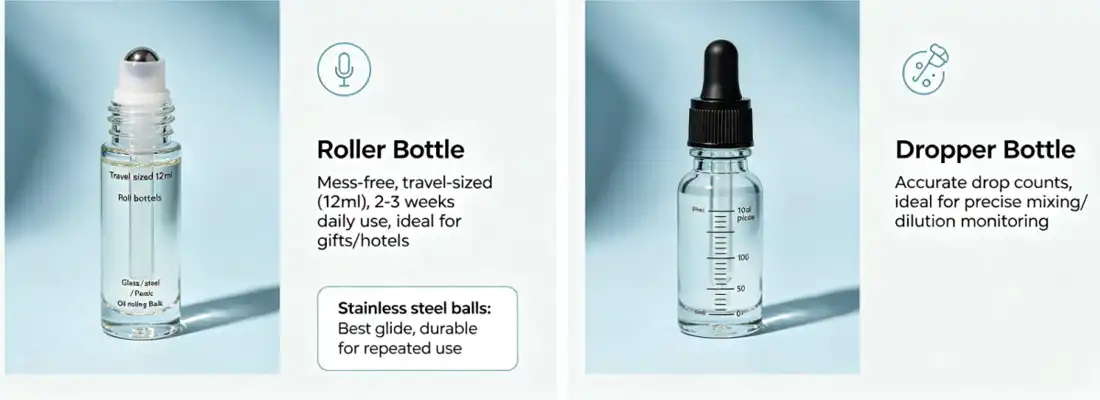
Roller shapes work best for travel-sized uses and aromatherapy mixes that are applied directly to the skin, where mess-free use is more important than precise volumetric use. The small essential oil bottle holds 12ml of product, which is small enough to fit in an aeroplane carry-on bag and enough for two to three weeks of daily use. This makes it perfect for gift sets and hotel amenity programs. Dropper bottles are useful for different things. Calibrated pipettes give accurate drop counts, which is useful for mixing operations that need to measure amounts or customers who want to keep an eye on dilution. Roller systems can use balls made of glass, steel, or plastic. Stainless steel balls give the best glide and last the longest when used over and over again.
Glass Versus Plastic: Durability and Cost-Efficiency Analysis
Glass cases cost more up front, but they are more cost-effective over their lifetime because they can be used again and again and improve brand image. Clients in the hospitality industry know that high-quality glass packing improves the guest experience and can support higher prices than plastic. Borosilicate glass has been tested for durability and can survive thousands of handling cycles without scratching or clouding. It also keeps its good looks over long periods of time. Plastic options are good for situations where cost is an issue and single-use distribution makes sense. However, regulations are becoming stricter on materials that can't be recycled through extended producer responsibility schemes. When disposal fees and company image effects of using plastic are taken into account, the cost calculations change in a big way.
Suitable Bottle Types for International Markets
In travel shopping and export situations, small sizes and resistance to impact are important. This makes 12ml glass cases with protective packing perfect for shipping across borders. Aromatherapy markets like golden glass because it shows that the product is natural, while beauty markets like clear glass because it shows off expensive serums and perfume mixes. European buyers often look for goods with recycled glass content as a requirement, while American sellers stress materials that are FDA-approved for products that come into contact with skin. By knowing these regional tastes, you can make tailored sourcing plans that meet the needs of a wide range of clients without keeping too many SKUs.
Procurement Guide: How to Source and Order Small Essential Oil Bottles in Bulk?
To buy in bulk efficiently, you need to know about the skills of the suppliers, the quality control methods, and the logistics issues that affect the total landed costs. Strategic buying turns packing from a cost that everyone has to pay for into a competitive advantage.
Bulk Purchasing Advantages and MOQ Considerations
When you commit to buying in bulk, you can access pricing levels that greatly increase your profit margins. For example, when you buy more than 5,000 units, you can usually get discount prices that save you 15% to 25% compared to buying in small batches. The minimum order quantity depends on how customised the product is. Stock bottles can be shipped at lower minimum numbers, but branded containers with hot stamping or engraving need higher amounts to make up for the cost of the tools. To find the right balance between inventory holding costs and per-unit prices, you need to be able to accurately predict demand. This is especially important for seasonal goods, where overstock risks are higher. Setting up vendor relationships that allow mixed orders, like mixing different cap colours or small essential oil bottle types, gives you options without giving up big savings.
Custom Branding Options Critical for Market Differentiation
Brand identity features turn plain packages into marketing tools that help people remember your brand and stay loyal to it. Metallic or coloured foil names are applied by hot stamping. These logos don't fade when handled, giving the product an expensive look on the shelf. With screen printing, you can use complex naming schemes and images with many colours and levels of detail. Inside carving creates small, lasting marks that can be seen through glass and show that the work was done by hand and is real. Custom labels are a cheap way to add your own design to smaller quantities or to change the design often, but the quality of the glue must match the storage conditions to keep the labels from peeling. Customisation of packaging includes the outer boxes. Coordinated display improves the unboxing experience, which leads to more activity on social media and return purchases.
Supplier Selection Criteria and Quality Standards
Verified makers keep certificates that show they follow international standards. For example, ISO 9001 quality management systems make sure that production processes are consistent and that the number of defects is kept to a minimum. Supplier sites should write down testing procedures that cover chemical inertness, leak resistance, and precise measurements that are specific to essential oil compatibility. Geographical factors are important for more than just price. For example, U.S. importers benefit from sellers who know FDA rules and can provide Certificates of Origin that make customs processing easier. European sellers put a high value on REACH compliance documents that show products meet strict chemical safety standards. Because Muzhishi has worked in the industry for 20 years, he knows how to deal with these complicated rules and regulations. This lowers the risk of noncompliance issues that could cause packages to be held up or rejected at ports of entry, which can be very expensive.
Optimizing Cost, Shipping, and Supply Chain Reliability
When figuring out the total landed cost, you have to take into account the different types of freight, duty rates, and wait times that affect the availability of your goods. Sea freight has the cheapest shipping rates per unit, but arrival times are eight to twelve weeks longer, which means that you have to plan ahead and keep working capital in transit inventory. When speed is worth the extra cost, air freight is the best way to go for urgent restocking or product launches. Setting up extra stocks at regional distribution centers helps protect against supply problems and speeds up last-mile delivery times, which makes customers happier. When negotiating payment terms—balancing prepayment savings against keeping cash flow stable—you need to look at the supplier's past order volume and financial stability. Long-term relationships often lead to good loan terms that make better use of operating capital without affecting the reliability of supplies.
Maintenance and Safety Tips for Small Essential Oil Bottles in B2B Usage
Handling rules after a buy have a direct effect on the safety of customers, the integrity of the goods, and compliance with regulations. Using routine repair methods to protect assets and improve operations is called operational excellence.
Cleaning and Refilling Procedures Minimizing Contamination
Commercial refilling operations need sterilisation methods that get rid of microbes and traces of the product that was used. Washing with hot water that is above 70 degrees Celsius and then rinsing with isopropyl alcohol gets rid of any oil leftovers that might affect the cleanliness of the next batch. Drying things in the air on clean racks keeps them from getting water spots that look bad and could introduce germs. Dedicated filling equipment with closed systems limits contact to air during transfer, which is especially important for oils that are sensitive to oxygen and easily go bad. Batch tracking systems that link bottle serial numbers to fill dates and product codes allow targeted recalls if quality problems show up. This shows due care and protects the brand's image and legal standing.
Labeling Strategies for Regulatory Compliance and Brand Trust
Label content must meet different transparency requirements in each country. For example, allergen warnings, ingredient lists, and usage directions protect consumers while also protecting companies from liability claims. Labels made of durable materials don't fall apart when exposed to oil or moisture, which can ruin the way a business looks. Waterproof plastic surfaces and UV-resistant inks keep the print legible for the whole shelf life of the product, even if the storage conditions are bad. Quick Response codes that lead to more information about the product and proof that it is environmentally friendly are clear and help customers trust the brand, and they save label room for legal text. Standardising labelling templates across all product lines speeds up compliance reviews and cuts down on design mistakes that could lead to expensive re-labeling.
Safety Precautions and Storage Best Practices
Childproof lids that meet 16 CFR 1700.20 standards keep kids under five years old from accidentally swallowing home goods with concentrated botanical compounds. This solves one of the most important safety problems. Corrugated barriers between individual bottles in shipping boxes keep them safe during travel and prevent breakage that could cause dangerous spills and product losses. Temperatures in climate-controlled warehouses are kept between 15 and 25 degrees Celsius, which keeps oil stable during storing times before it is distributed. Staff training on how to handle dangerous materials makes sure that the right steps are taken to clean up and deal with spills, which protects the environment and keeps workers safe. These procedures show that operations are mature, which reassures business clients and makes insurance companies happy when they're figuring out how much danger there is.
Conclusion
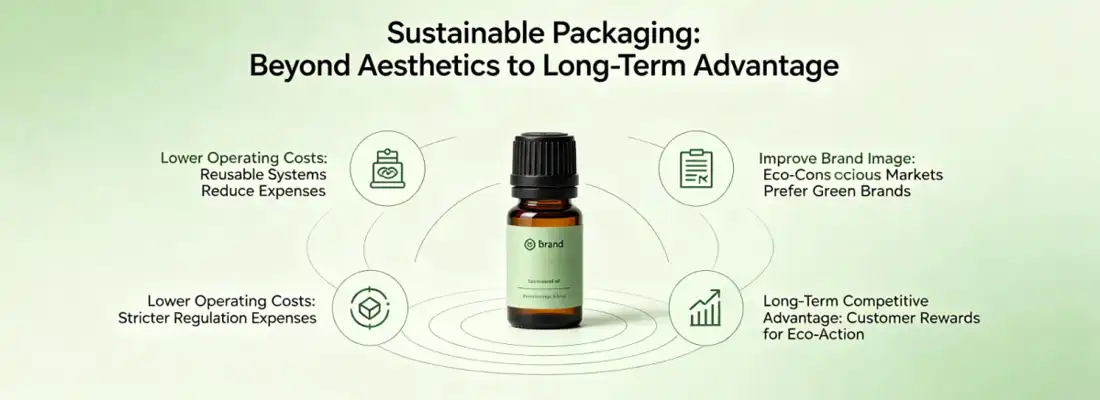
Sustainable package options have real benefits that go far beyond looking good for the environment. They lower operating costs through reusable systems, improve brand image in markets that are becoming more eco-conscious, and meet legal requirements that will only get stricter in the coming years. The small essential oil bottle is a beautiful way to protect products while also taking care of the environment, especially if you buy them from companies that really care about quality and the environment. Today's strategic buying choices set a company up for long-term competitive advantage that grows over time as customers reward companies that act in ways that are good for the environment. Companies that use eco-friendly packaging are now seen as stars in their field, rather than reactive followers who are trying to keep up with changing consumer standards.
FAQ
What minimum order quantities should we expect for bulk glass bottle purchases?
Shipping minimums for standard stock bottles are usually between 1,000 and 3,000 units. Custom-branded containers with special printing or branding usually need between 5,000 and 10,000 units to cover the costs of setting up the tools. Suppliers with flexible MOQs let smaller brands get good packing without taking on too much inventory risk, but prices per unit go down a lot as numbers go up.
How do we verify genuine eco-friendly compliance in supplier claims?
Ask for proof of certifications like ISO 14001 environmental management standards, FSC-certified packing materials for the outside boxes, and third-party testing results that say the glass can be recycled and doesn't contain any banned substances. Instead of depending only on marketing claims, transparent sellers give access to factory audits and thorough sustainability reports that measure carbon loads and waste reduction efforts.
Can we combine different cap colors within single bulk orders?
Many makers can handle mixed orders by dividing the quantities among different colour versions. This lets brands see what the market wants or serve more than one product line without having to keep separate inventory pools. This freedom is especially helpful when a new product is being released and demand patterns aren't clear yet. It lowers the risk of failure that comes with committing to a single SKU.
Partner with Muzhishi for Premium Small Essential Oil Bottle Solutions
Xuzhou Muzhishi has been making glass for twenty years and can help businesses find trusted small essential oil bottle suppliers who understand the need for sustainability and the needs of the market. Our 12ml borosilicate glass roller bottles are made with high-quality materials and have useful design features, such as square bases that keep them from rolling, cap colours that can be changed to better reflect your brand, and fast sampling services that get samples to you in three to five days. We offer a wide range of customisation options, including hot stamping, screen printing, and engraving. Our dedicated account managers make sure that contact is smooth from the first question to the final delivery. Our Jiangsu facility takes advantage of benefits in the regional supply chain to cut costs by ten to fifteen percent while still meeting international quality standards. We offer full export paperwork and quick after-sales support at long@muzhishi.com. Go to mzsglass.com to see our eco-friendly packing options for companies that want to take their essential oil product lines to the next level.
References
1. Marsh, K. & Bugusu, B. (2007). "Food Packaging—Roles, Materials, and Environmental Issues." Journal of Food Science, 72(3), R39-R55.
2. Verghese, K., Lewis, H., Lockrey, S. & Williams, H. (2015). "Packaging's Role in Minimizing Food Loss and Waste Across the Supply Chain." Packaging Technology and Science, 28(7), 603-620.
3. Steenis, N.D., van Herpen, E., van der Lans, I.A., Ligthart, T.N. & van Trijp, H.C.M. (2017). "Consumer Response to Packaging Design: The Role of Packaging Materials and Graphics in Sustainability Perceptions and Product Evaluations." Journal of Cleaner Production, 162, 286-298.
4. Wikström, F., Williams, H., Verghese, K. & Clune, S. (2014). "The Influence of Packaging Attributes on Consumer Behavior in Food-Packaging Life Cycle Assessment Studies." Journal of Cleaner Production, 73, 100-108.
5. Magnier, L. & Crié, D. (2015). "Communicating Packaging Eco-Friendliness: An Exploration of Consumers' Perceptions of Eco-Designed Packaging." International Journal of Retail & Distribution Management, 43(4/5), 350-366.
6. Simon, B., Ben Amor, M. & Földényi, R. (2016). "Life Cycle Impact Assessment of Beverage Packaging Systems: Focus on the Collection of Post-Consumer Bottles." Journal of Cleaner Production, 112, 238-248.

Our customers’ satisfaction speaks for our quality — contact us to experience the same reliable service.